
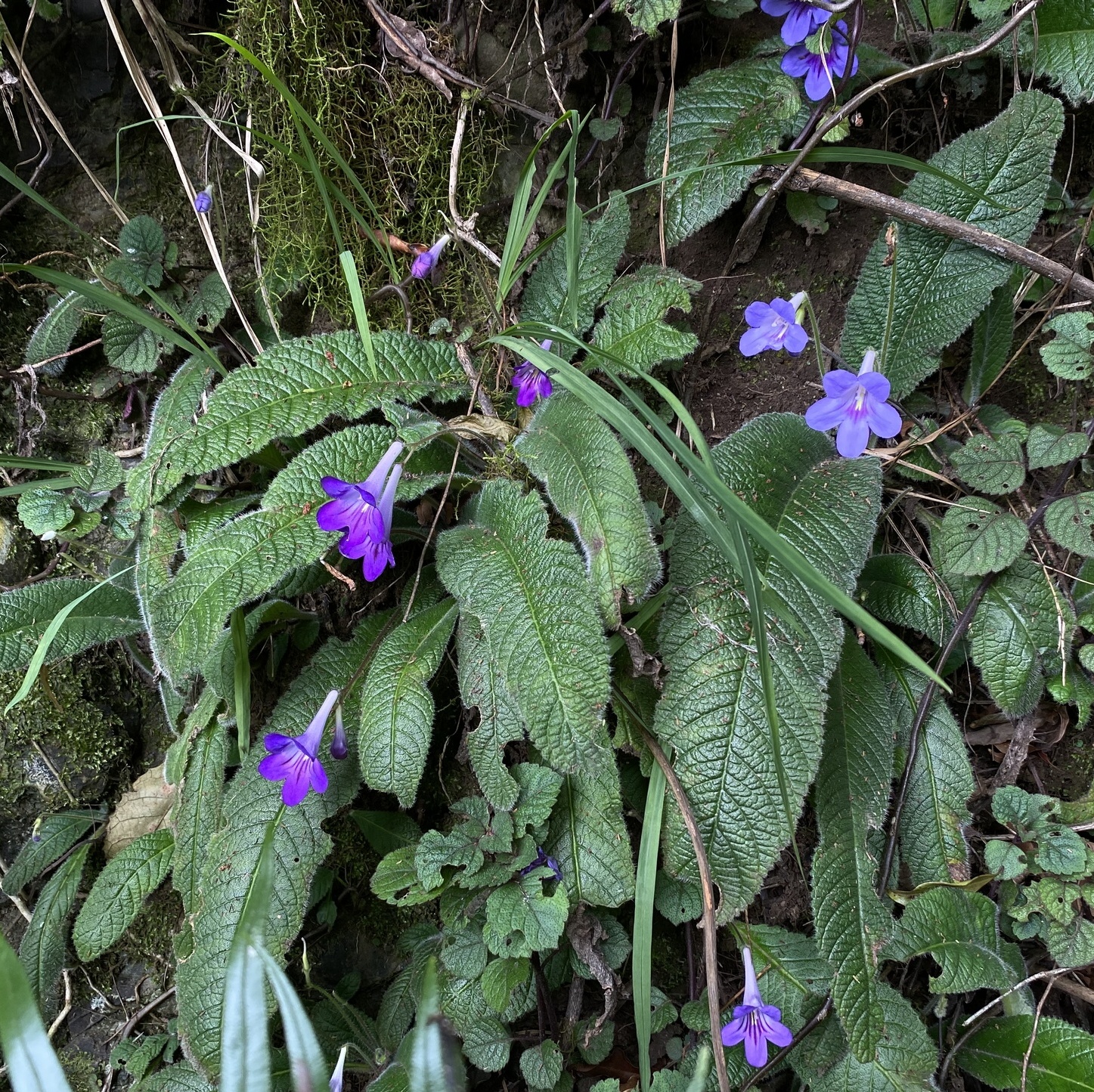
Streptocarpus cyaneus occurs on the great eastern escarpment of southern Africa in localities from Eswatini (former Swaziland) through Mpumalanga Province (English translation: “where the sun rises”) to the most northerly province of South Africa, the Limpopo Province. In the monograph on the genus Streptocarpus published by Hilliard and Burtt in 1971, they described the problems of trying to unravel the taxonomy of Streptocarpus cyaneus and its sister species, Streptocarpus parviflorus.
Weigend and Edwards studied the morphology and defined subspecies of these two species in an effort to better define the groups. Morphometric and DNA studies by Goodwin (2006) and Moeller, and De Villiers (2008) and Bellstedt tried to establish the relationships between and within these two species, but a very complex picture emerged which requires much more research in order to clearly define this species and its subspecies specifically. Weigend and Edwards did separate distinct species from the Streptocarpus cyaneus complex which they described as Streptocarpus actinoflorus, Streptocarpus fenestra-dei, Streptocarpus floribundus, Streptocarpus kunhardtii, and Streptocarpus roseoalbus which are all presented separately on the GRW.
Streptocarpus cyaneus grows in shaded forest or deeply shaded gorges with a high moisture content on rock faces, earth embankments and epiphytically. The species shows incredible variation from small plants with a few short leaves to much larger plants with leaves up to 45 cm long. The flower morphology also varies from short (25 mm) to long (80 mm) tubes in shades from white to blue and deep mauve, most have yellow markings on the floor of the corolla, and many have seven to eleven violet lines, some distinct, others only faint.
The question is how did this variation come about?
Over the past two million years, the earth has undergone repeated 100,000 year glacial cycles, during which ice sheets form at the poles but this draws moisture away from the subtropics. This results in an expansion of grasslands in the subtropics and a contraction of forest patches which was particularly evident in the area where this species occurs. During glacial periods, their habitat and their population sizes shrunk, as a result of which they randomly evolved into all of these shapes and sizes through what is called genetic drift, a mechanism which is particularly evident in small populations. During the wetter interglacial periods, the forest habitat expanded, the populations became larger and sometimes they came into contact again, allowing interbreeding and thereby generating new forms. The result is a nightmare for taxonomists that want to assign a species based on a tight set of measurements and distinctive characters.
The original type specimen for the species comes from Eswatini (former Swaziland), Piggs Peak, Forbes Reef (known for its gold mining, hence reef). However, the species description was written in an attempt to cover all the variation in the species. It was described as a rosulate perennial species with oblong-lanceolate leaves (up to 450 x 125 mm) with distinct petiolodes up to 60 mm long. The flowers are funnel shaped, up to 7 flowered, 30-80 mm long, white to purple, yellow stripe on the floor of the tube with mostly 7 but up to 11 violet lines running into the lower lip. The mouth of the tube is 8-15 x 10-20 mm wide, lobes suborbicular to oblong, porrect to slightly reflexed, skyblue, mauve, lilac or deep purple, 8-15 x 8-18 mm. Indeed a very broad description!
The current taxonomy accepts four subspecies of Streptocarpus cyaneus:
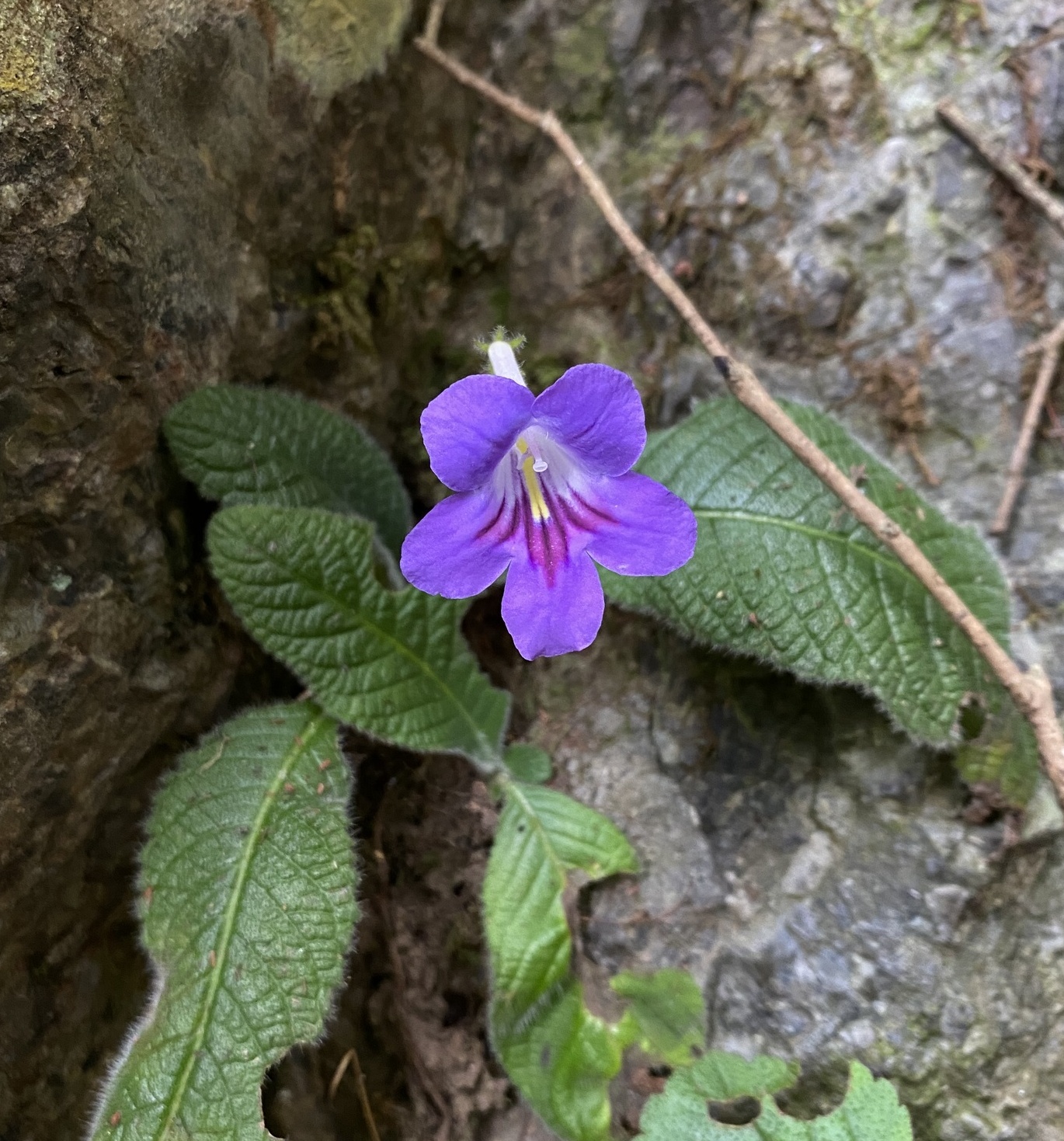
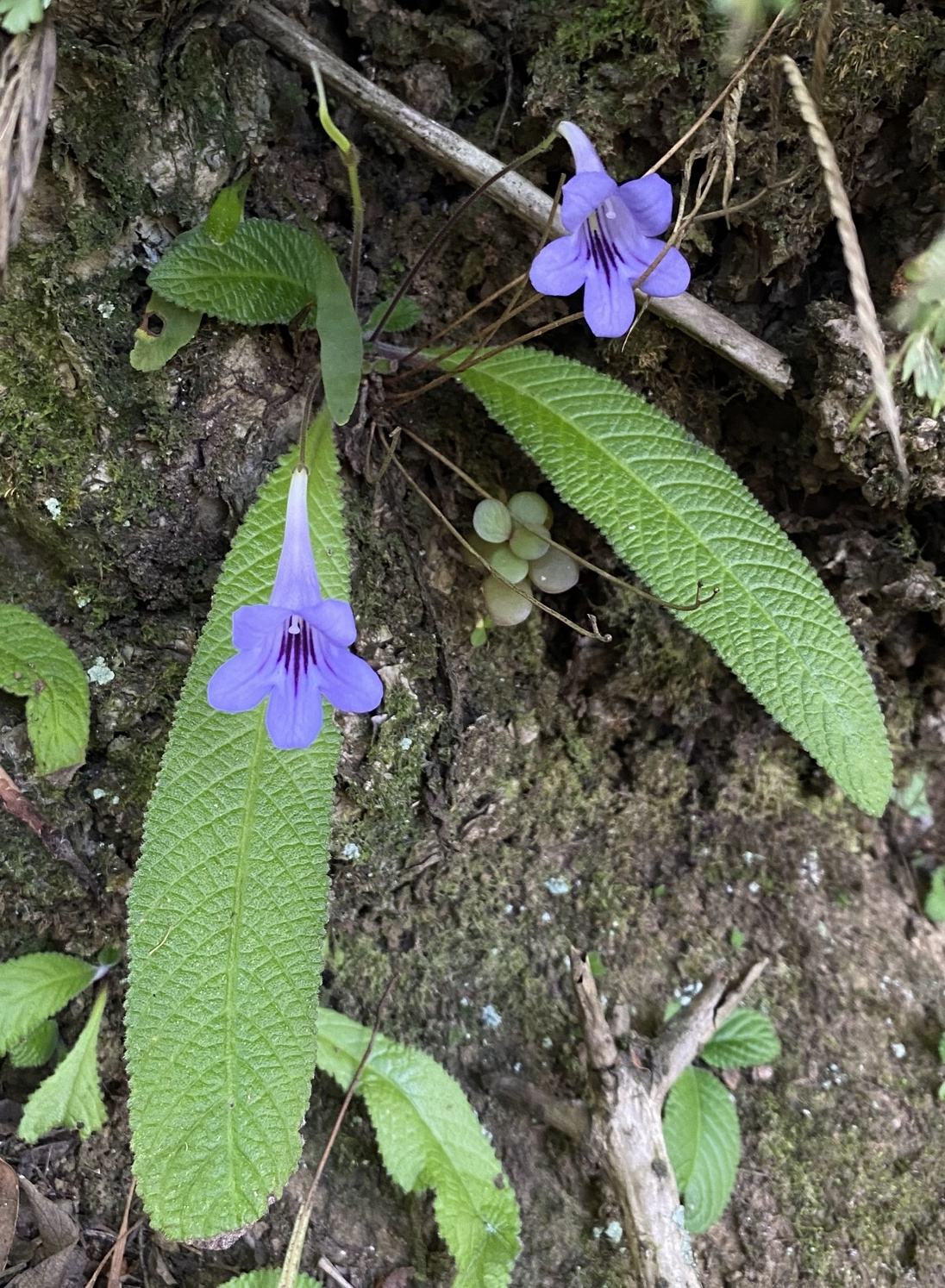
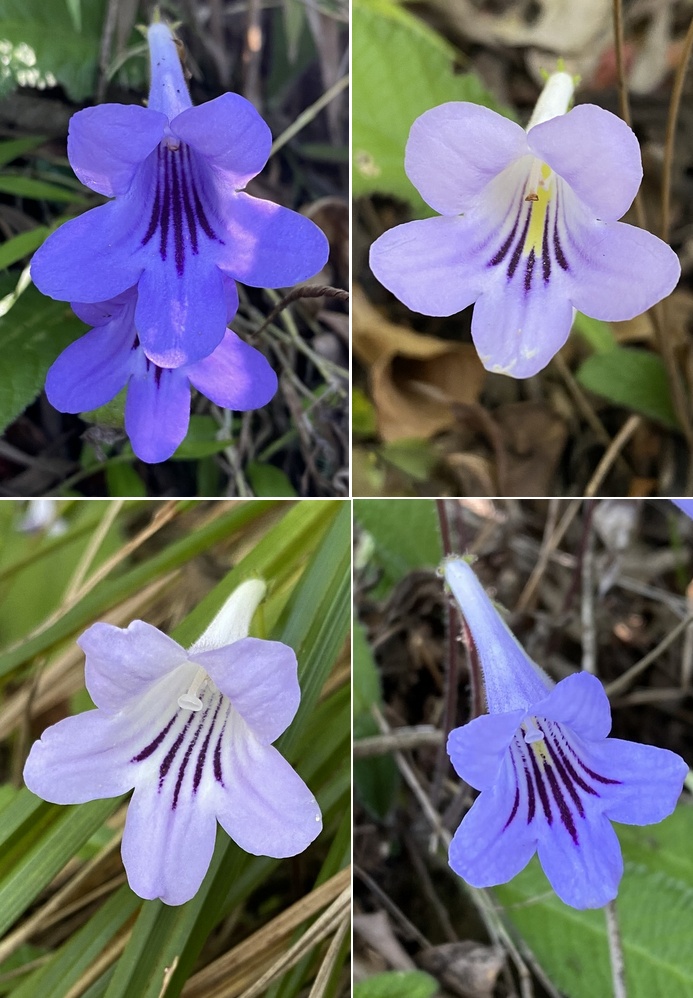
Streptocarpus cyaneus ssp. cyaneus, the feature photo above, grows in the border area of Eswatini and Mpumalanga in the Barberton and Mbabane vicinity. It is a smaller rosulate species with numerous sub-erect strap-shaped leaves (up to 350 x 50 mm). The flowers are funnel shaped (30-55 mm long), tube white to light mauve, with a bold yellow stripe on the floor of the tube with 7 violet lines running into the lower lip, limb pale blue-violet to purple. The mouth of the tube is 15 mm across and the lobes broad, up to 15 x 7 mm. Note in the feature photo above, of this subspecies, the variation in flower color in adjacent plants.
- Streptocarpus cyaneus ssp. cyaneus flower and plant
- Streptocarpus cyaneus ssp. cyaneus flower variants
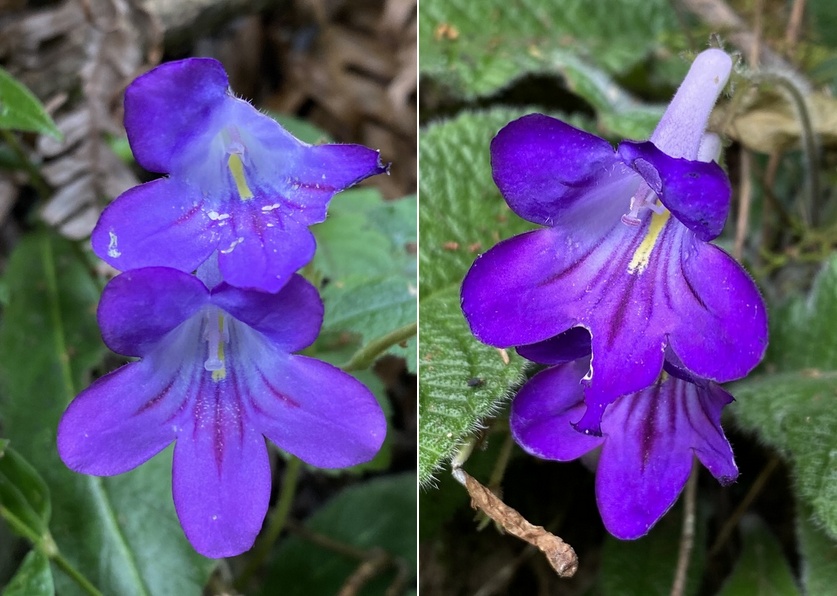
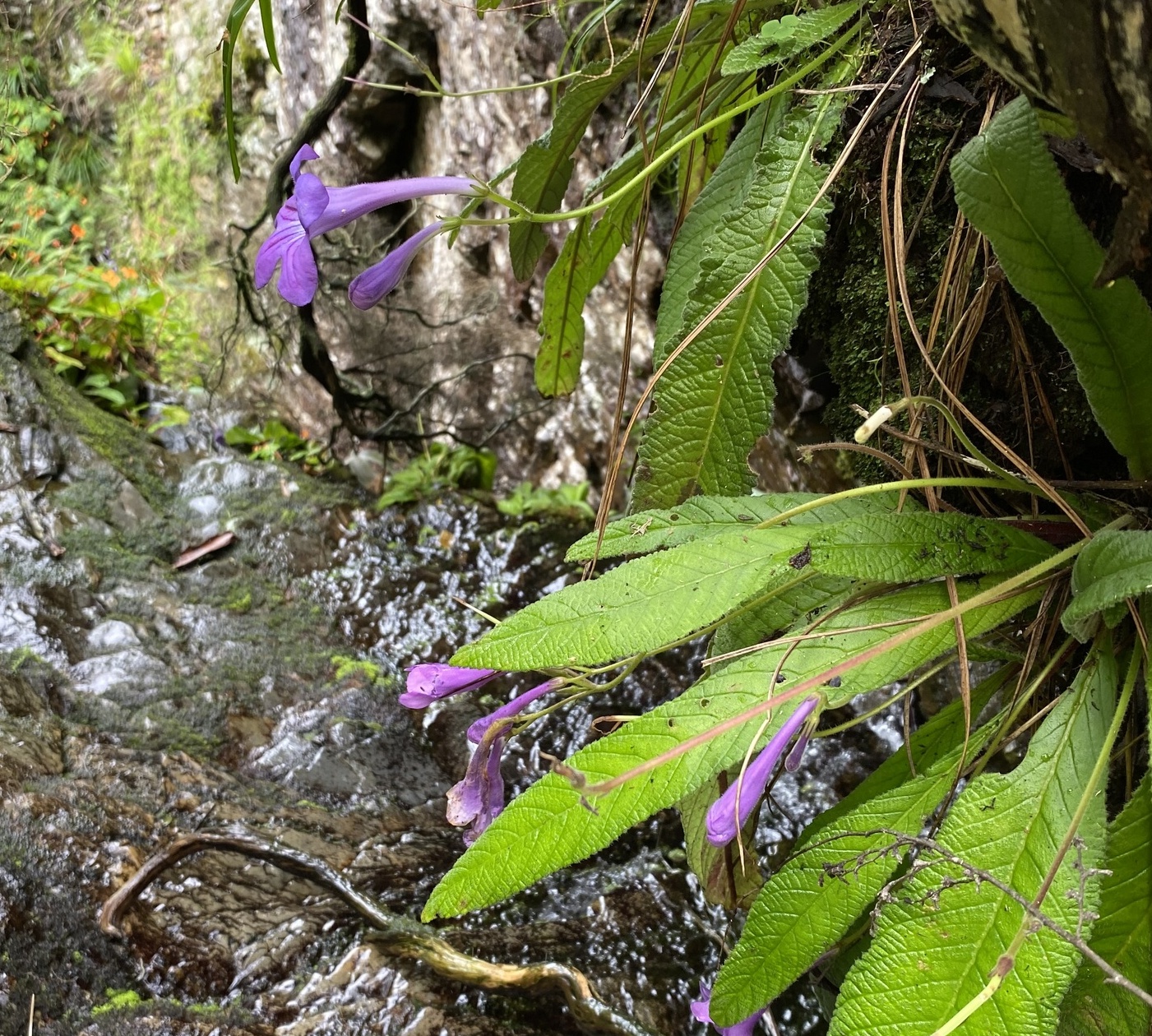
Streptocarpus cyaneus ssp. longi-tommi grows in the vicinity of Long Tom Pass where the Boers used the so-called Long Tom cannon with great success in the Anglo-Boer war (1899-1902). It grows at a location in which a small stream flows at a very steep angle on the rock face, appropriately named “Die Geut” in Afrikaans, meaning “The Gutter”. It is a rosulate species with strap-shaped leaves (up to 400 x 50 mm) with 1-3 flowers per leaf. The large flowers are funnel shaped, purple and up to 80 mm long, with a distinct bend. The mouth of the tube is 15- 20 mm across. There is a bold yellow stripe on the corolla floor extending onto the limb with 7 -11 deep purple lines. The 2 upper lobes are reflexed, and the lower three are projected forward and slightly bent back at the tips.
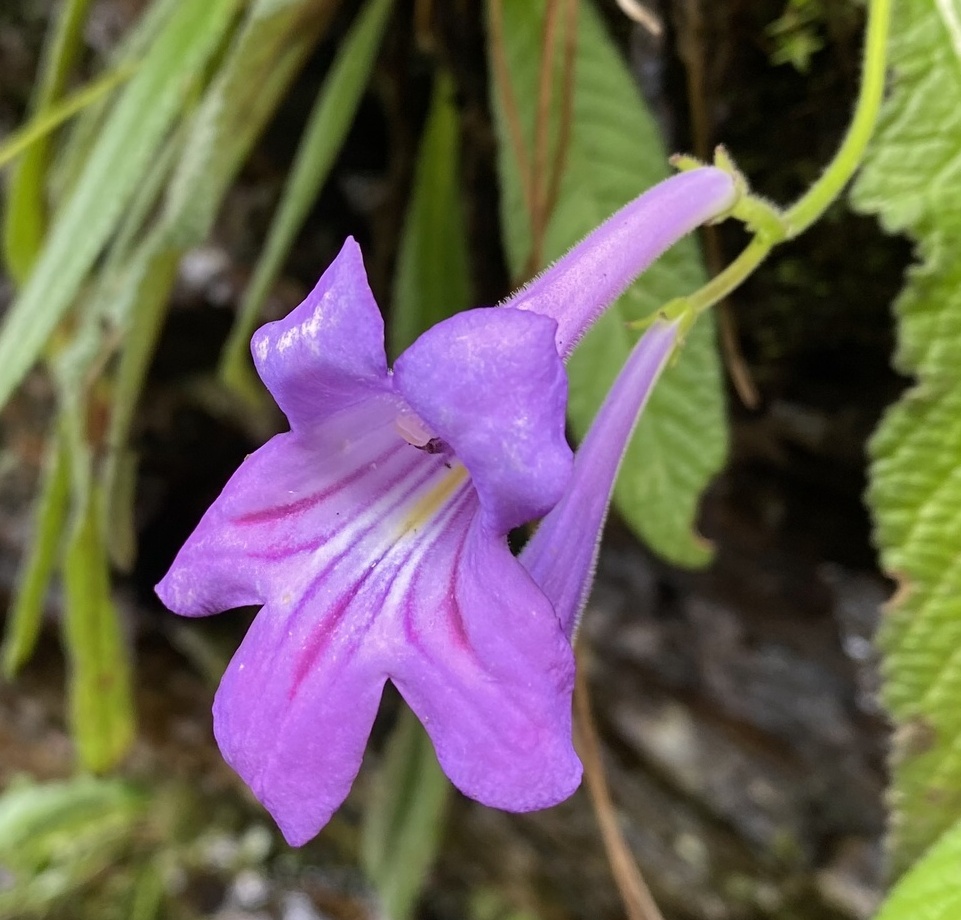
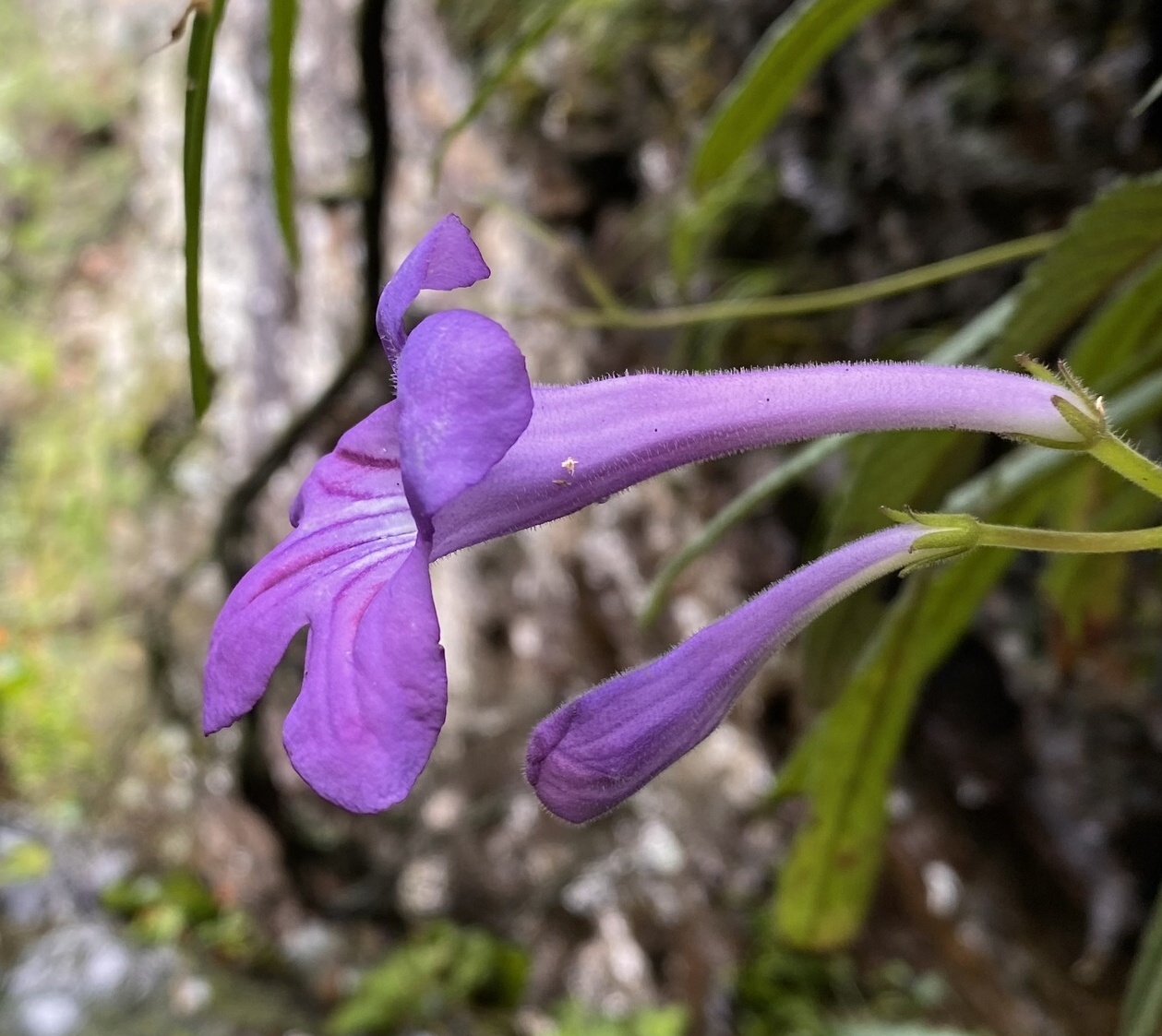
Streptocarpus cyaneus ssp. nigridens grows in the northern areas of the S. cyaneus range from Mariepskop to the eastern Zoutpansberg. It is a rosulate species with sub-erect strap-shaped leaves (up to 250 x 50 mm). Each leaf produces an inflorescence of 3-8 flowers. The flowers are funnel shaped and shorter (25-30 mm long), and white to light mauve. The mouth of the tube is 10 mm across. There is a pale yellow stripe on the corolla floor extending onto the limb with 7 fine dark lines. The lobes are usually pale blue, rarely sky blue or pale lilac, all lobes are projected forward, up to 15 x 7 mm.
- A plant with beautiful pale flowers growing in a rock cleft
- A colony of ssp. nigridens, growing on mossy rocks
- A block illustrating different flower colors/forms of ssp. nigridens
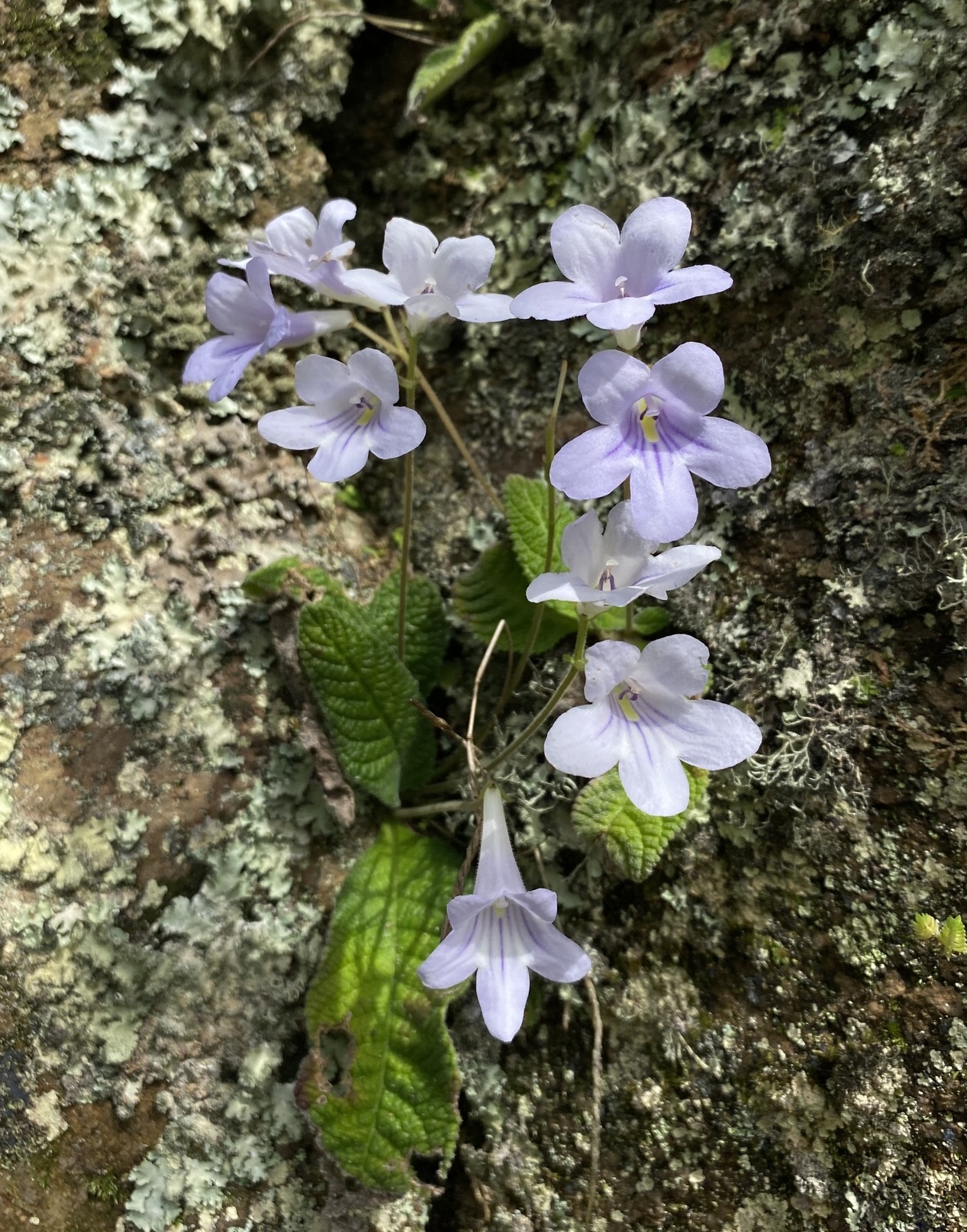
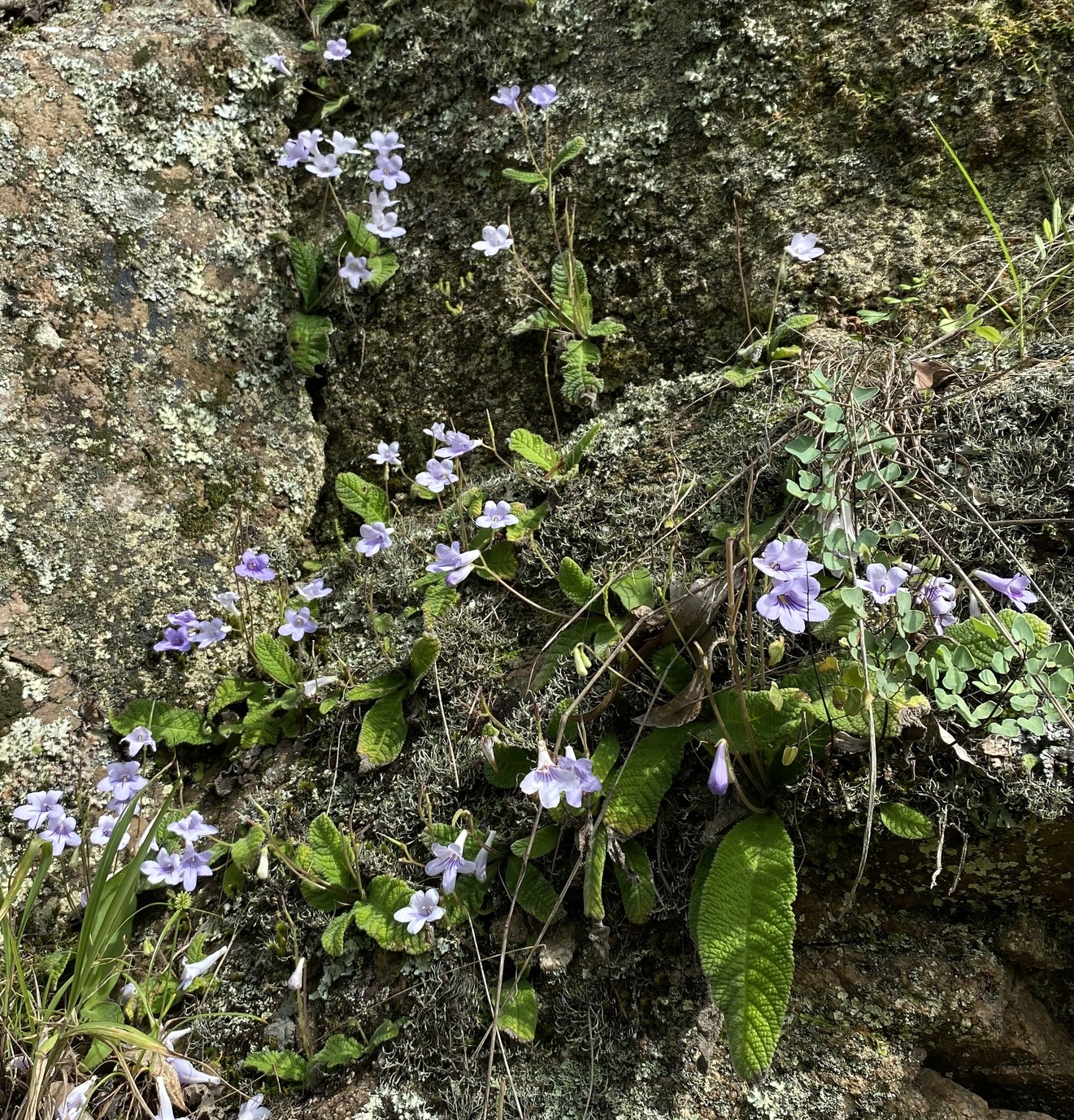
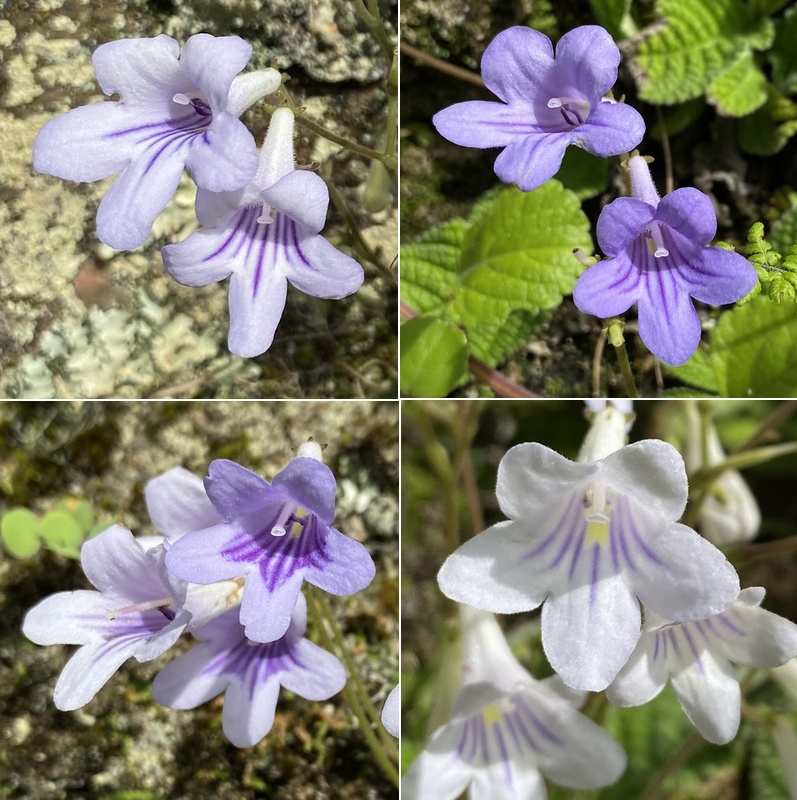
Streptocarpus cyaneus ssp. polacki grows in the Graskop, Pilgrimrest and Sabie areas. It is a rosulate species with sub-erect strap-shaped leaves (up to 400 x 50 mm). Each leaf produces an inflorescence of 1-3 flowers. The flowers are funnel shaped and up to 70 mm long and white or palest blue lilac. The mouth of the tube is 15 mm across, sometimes with a pale yellow stripe and 7 fine dark lines on the corolla floor. Lobes oblong, blue, the upper two are reflexed, and the lower three are projected forward, up to 15 x 7 mm.
These are the typical forms of Streptocarpus cyaneus but the species has many variants, almost a different one in each of the over hundred forest patches over its whole distribution range. One of these likely variants is shown here which has a pale white flower, with the characteristic yellow throat, but is found in a few dry and exposed localities on dolerite rocks west of Lisbon, Mpumalanga Province, South Africa.
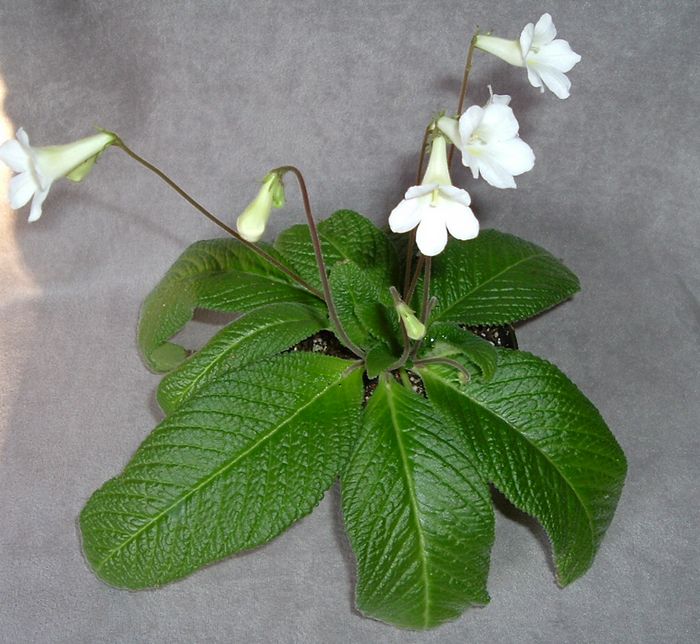
The species is not commonly cultivated, probably because of the unavailability of seed, but it has potential as an attractive species in its own right or for producing hybrids. It is important for horticulturists and hybridizers to keep accurate records of where their original collections came from in order to keep a record of species and subspecies.