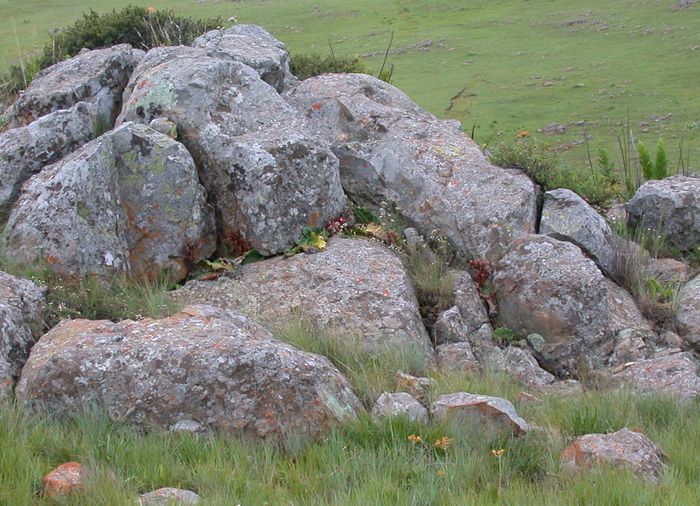
Streptocarpus dunni has a distribution which forms a rough triangle between the towns of Barberton, Lydenburg and Thuli Fakude (formerly Leslie) in Mpumalanga Province, South Africa, but is also recorded from eastern Eswatini (formerly Swaziland). It grows on rock outcrops or steep embankments where it displays it red flowers for pollination by the brilliantly coloured malachite sunbird (Nectarinia famosa). Together with the other red-flowered species, Streptocarpus myoporoides from Mozambique, it appear to have adapted its colour to red to attract sunbird pollinators.
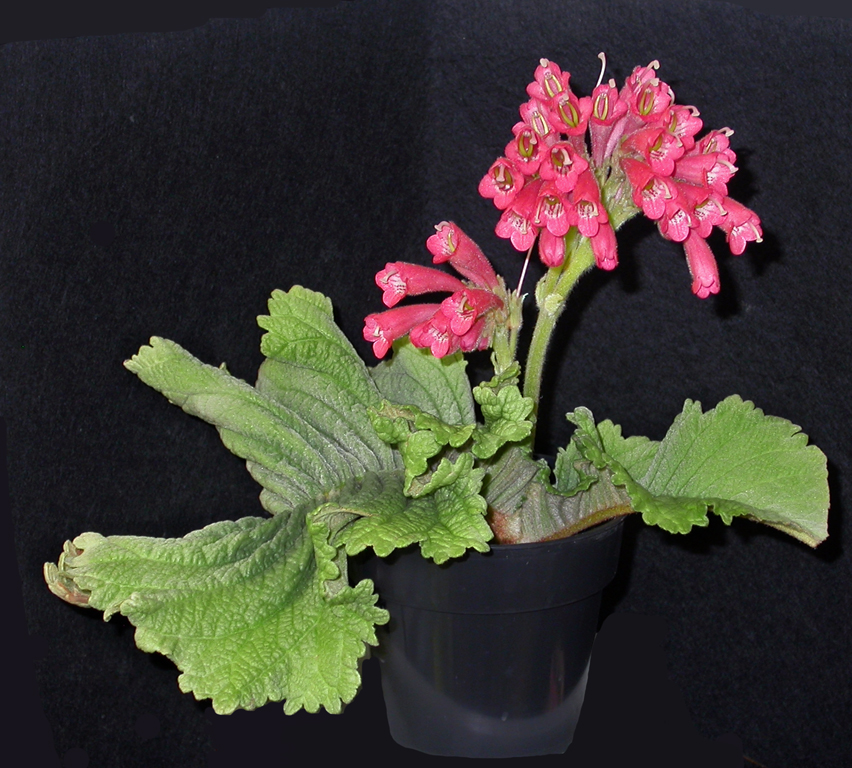
Most populations are unifoliate and monocarpic, but a rosulate, perennial form, previously described as Streptocarpus armitagei until combined with Streptocarpus dunni, is known from the vicinity of Barberton at Angle Station, although other rosulate populations are known from across its range.
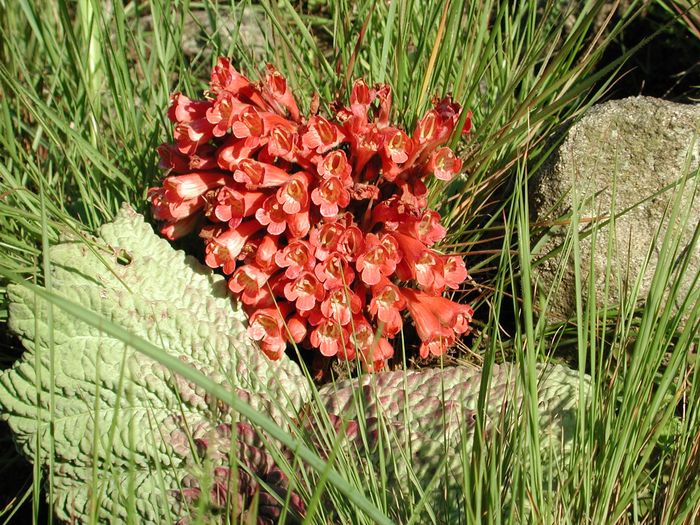
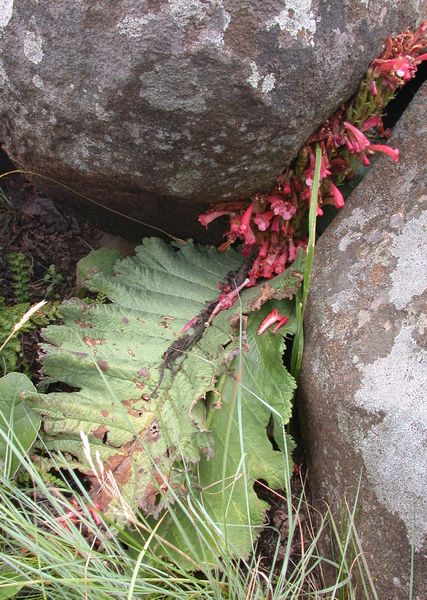
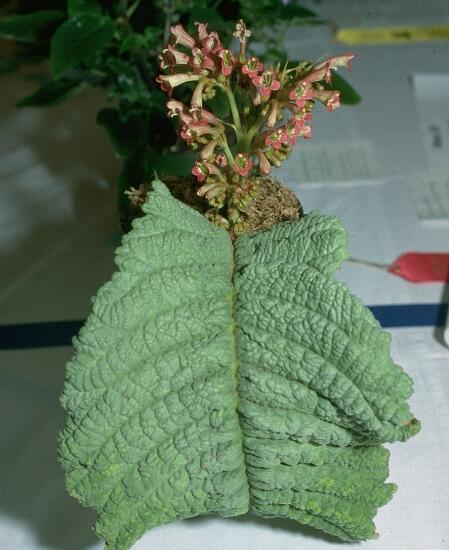
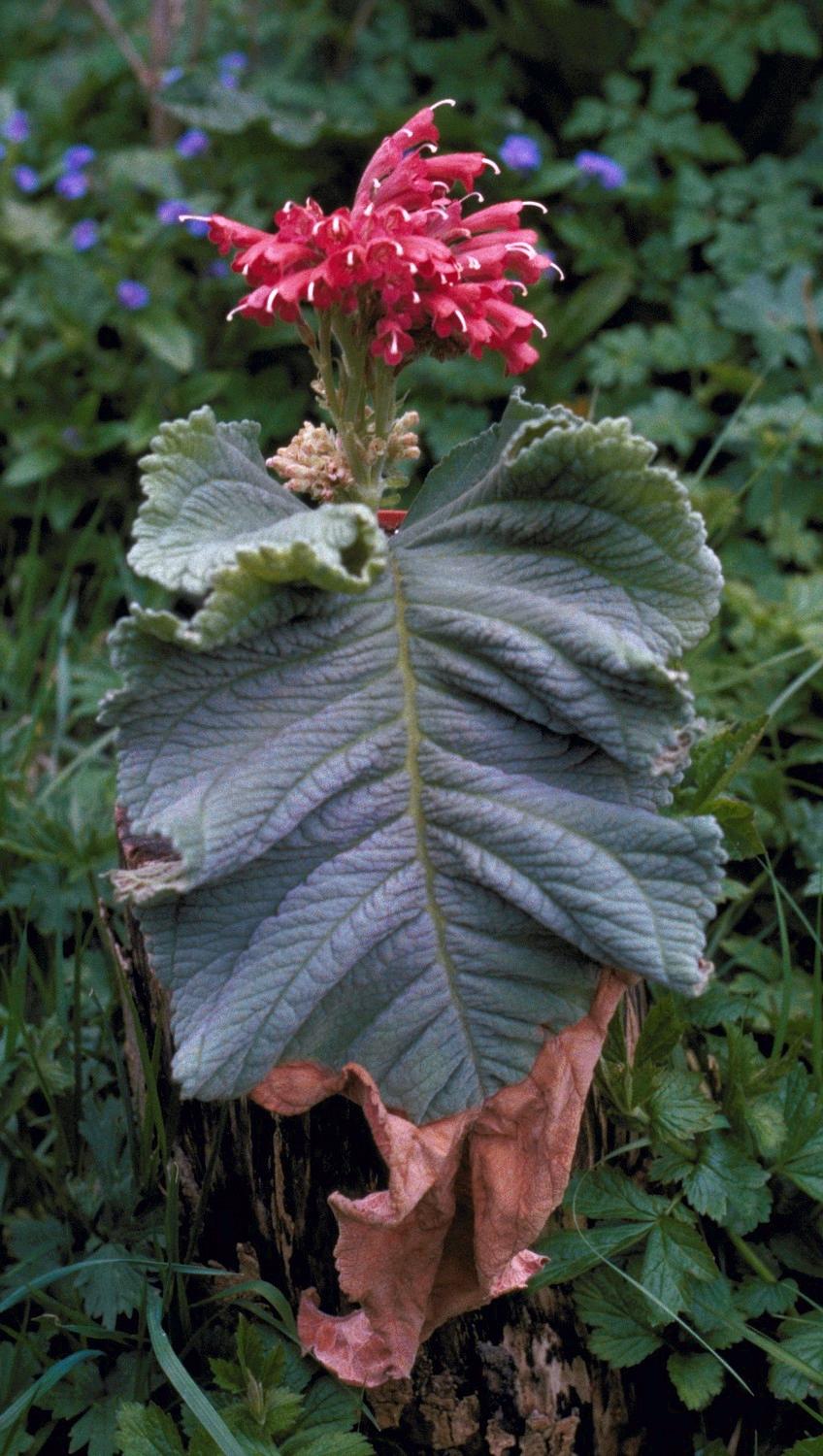
S. dunnii is the source of all of the red color in hybrid Streptocarpus. Its single leaf is particularly distinctive due to its usual grayish-green tone. Note the “abscission zone”, the portion of the leaf that has died off. The ability to jettison a portion of the leaf allows the plant to survive dry seasons by reducing the amount of surface area subject to transpiration of water.
Additional photos can be seen in a slideshow by clicking one of the links below:
- A closer view of the flowers on the feature plant above
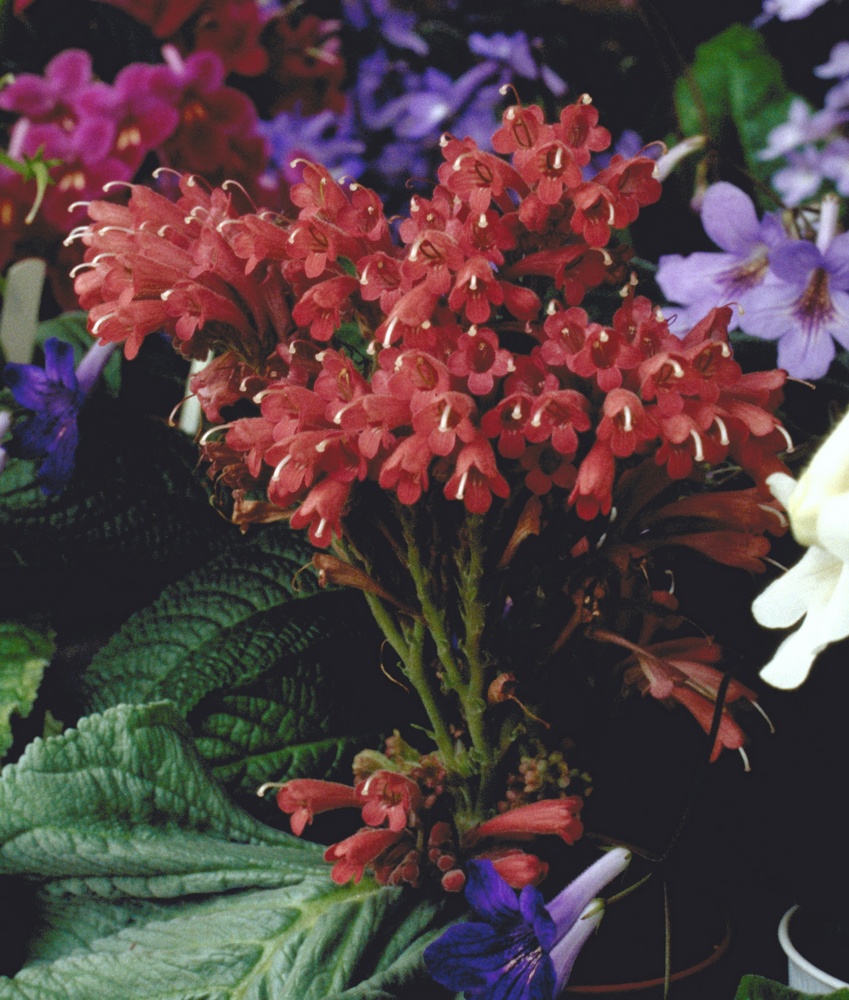
- A close view of the flowers on another plant, amidst a number of hybrids
- A steep rocky landscape dotted by beautifully contracting plants of S. dunnii
- A close view of the flowers on a plant in the landscape
- Another view of the natural habitat of the species in South Africa
- A plant growing in a small seam in a rock
- A plant exhibited in the 2021 virtual show of the Gesneriad Society
- One of the very first times S. dunnii was exhibited in a flower show; note that this plant has paler flowers than those in the rest of the pictures, illustrating a wide range of variation in the species
- A variant of the species, S. dunnii JT 10303, which has a plurifoliate form