
Streptocarpus exsertus was described by Hilliard and Burtt in 1971 in their monograph of the genus. It had been collected by J. Wilson (J. Wilson 1336) in 1963 in the Chemorongit Hills, Kenya, in the remote far north west of the country in the extremely arid Turkana Province west of Lake Turkana close to the Ugandan border. A second collection was made by B. Bytebier (Bytebier 564) in 1995 on the summit of Mt Ololokwe, in Samburu County, Kenya, which lies about 50 km north of the town of Isiolo.
These two localities lie some 300 km apart. It only occurs on high mountain crowns where there is some moisture, probably in the form of mists. With very little suitable habitat to grow on, this species must be very rare in nature.
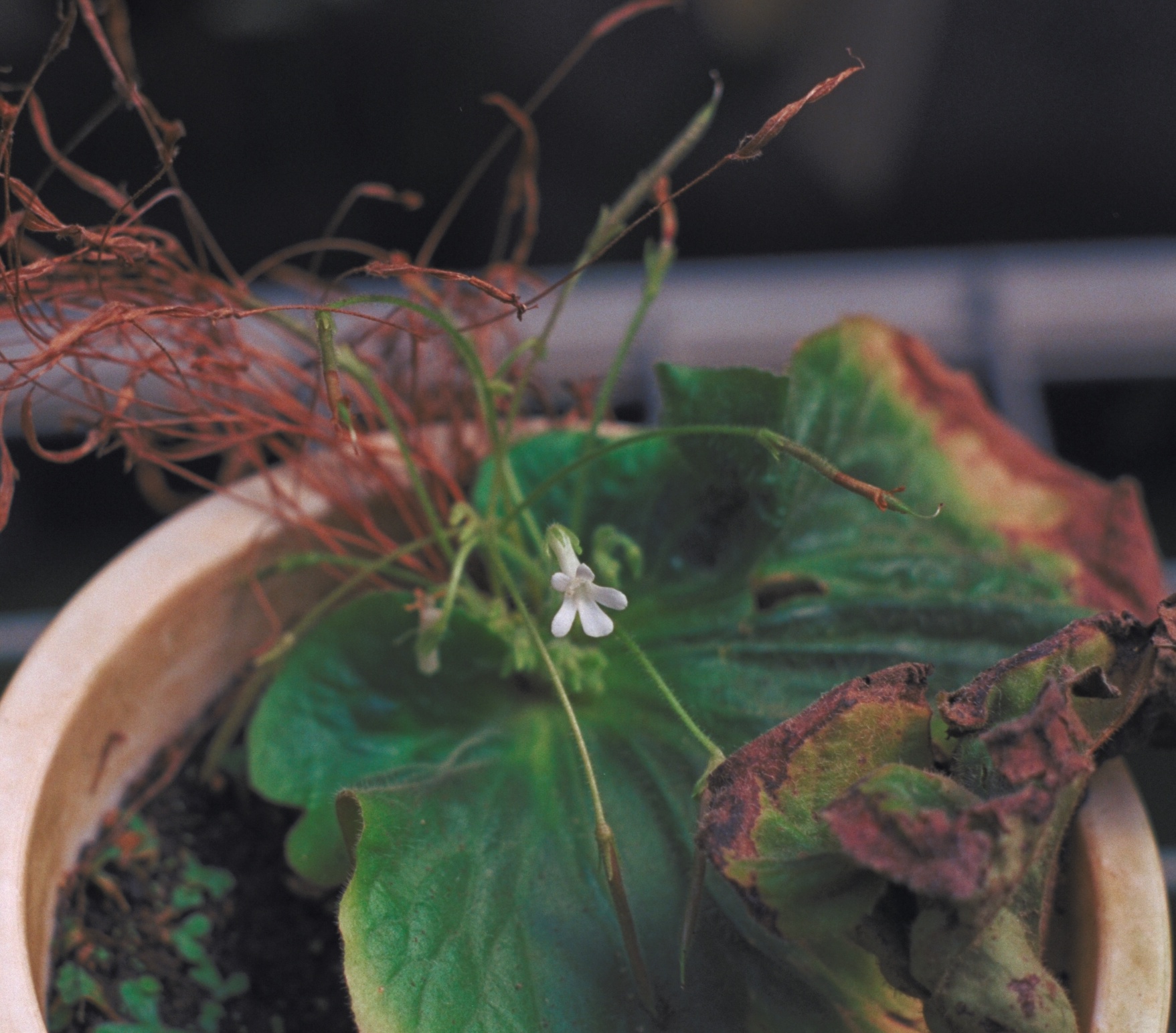
It was collected by Bytebier in the form of an earthen sod found in a minicave, on which he had noticed what appeared to be dead plants with twisted seed capsules. He had hoped that the seeds would grow. However, when the sod was watered, the dead plants became green again, and they continued to grow and flower. This property is described as poikilohydric and is an extreme mechanism against drought possessed by some so-called desiccation plants. One of these plants growing at the Kenya National Museum is shown as the feature photo above. It is thought to be a link between the more southerly growing Streptocarpus species and the single species, Streptocarpus phaeotrichus, which occurs in Ethiopia.
Streptocarpus exsertus is a unifoliate (leaf 30-90 x 15-65 mm) with leaves on a distinct petiolode (5-45 mm long). The plant is almost entirely covered in hairs up to 2 mm long to protect against moisture loss, but also to capture moisture from mist. Numerous inflorescences arise at the top of the petiolode with up to 5 flowers open at the same time. Corolla, white, 4-5 mm long, 2 upper lobes 1.5 x 2 mm, 3 lower lobes 2 x 4 mm for the two outer lobes, 3 x 4 mm for the central lower lobe. It is named after its exserted anthers that are unusually extended from the corolla mouth in comparison to other Streptocarpus. A real oddball species not commonly in cultivation.