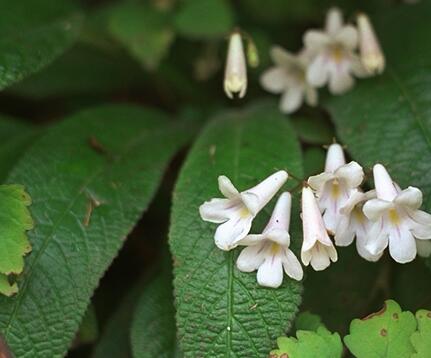

Streptocarpus parviflorus occurs in the most northerly province of South Africa, the Limpopo Province, on its eastern escarpment, between the towns of Polokwane to the west and Tzaneen in the east in the Woodbush, Magoebaskloof and Haenertburg areas. In addition it also occurs to the north in the eastern Zoutspansberg Mountains, east of the town of Louis Trichardt. In their monograph on the genus Streptocarpus published in 1971, Hilliard and Burtt described the problems of trying to unravel the taxonomy of Streptocarpus parviflorus and its sister species, Streptocarpus cyaneus. They stated that more research was required to resolve these taxonomic problems. Weigend and Edwards studied their morphology and defined subspecies of these two species in an effort to better define the groups. Morphometric and DNA studies by Goodwin (2006) and Moeller, and De Villiers (2008) and Bellstedt tried to establish the relationships between and within these two species, but a very complex picture emerged which requires much more research in order to clearly define this species and its subspecies specifically.
All variants of Streptocarpus parviflorus grow in shaded forest or deeply shaded gorges with a high moisture content on rock faces, earth embankments and even epiphytically, an important consideration if you wish to cultivate them.
The typical form of Streptocarpus parviflorus, which is described from the Woodbush Forest Reserve area, is a rosulate species with numerous strap-shaped almost erect leaves (up to 450 x 125 mm) with distinct petiolodes (15 x 7 mm). The flowers are funnel shaped and relatively short (20-30 mm long), white, sometimes suffused palest violet or soft pink, with a yellow strip on the floor of the tube with 7 violet lines running into the lower lip but sometimes completely absent. The mouth of the tube is 7-15 mm across and the lobes 4-8 x 4-7 mm.
Streptocarpus parviflorus ssp. parviflorus is more narrowly defined as a rosulate species with numerous strap-shaped almost erect leaves (up to 450 x 70 mm) with distinct petiolodes. Each leaf produces an inflorescence of 2-3 flowers with up to 20 flowers open on a plant at a time. The flowers are funnel shaped and relatively shorter (13-18 mm long), always white. The mouth of the tube is 7-8 mm across. The subspecies occurs at the Woodbush Forest Reserve, Haenertsburg, Soutpansberg and Mariepskop further to the south.
Streptocarpus parviflorus ssp. soutpansbergensis is even more narrowly defined as a rosulate species with numerous oblong-lanceolate shaped leaves (up to 270 x 55 mm) with distinct petiolodes. Each leaf produces an inflorescence of 2-3 flowers with up to 20 flowers open on a plant at a time. The flowers are funnel shaped and slightly longer (25-30 mm long), and soft pink. The mouth of the tube is 8-10 mm across. The subspecies occurs in the eastern Zoutpansberg in the so-called Waterpoort near Louis Trichardt, but also in the Hanglip Reserve and areas up to about 30 km east.
The species is not commonly cultivated, probably because of the unavailability of seed, but it has potential as an attractive species in its own right or for producing smaller hybrids. As this species is quite variable, it is important for horticulturists and hybridizers to keep accurate records of where their original collections came from in order to keep a record of species and subspecies.
Exhibited at the 2010 convention of the Gesneriad Society.
Another plant can be seen here.