
The big DNA analysis of Nishii et al. (2015), in which were included representative species from across Streptocarpus and Saintpaulia as well as other minor genera, revealed new patterns of phylogenetic relationships. Based on this new phylogeny the classification of species within Streptocarpus was changed, achieving much greater clarity. The phylogeny indicated that there are two clades containing respectively two sections (Hova and Parasaintpaulia) and three sections (Colpogyne, Lignostreptocarpus and Plantaginei), that are found only in Madagascar whilst all of the other sections are found in Africa.
If this is analyzed with biogeographic methods, this gives support to the hypothesis that there were two independent dispersals of Streptocarpus to Madagascar from Africa. Again, this idea is not new, as this was proposed by Hilliard and Burtt many years ago.
In the new classification of genus Streptocarpus by Nishii et al. (2015), the genus still subdivides into the two previously recognized subgenera but with new circumscriptions and 12 newly defined sections.
- Subgenus Streptocarpella:
- Section Carnosifolii
- Section Caulescentes
- Section Hova
- Section Parasaintpaulia
- Section Saintpaulia
- Section Schizoboea
- Section Trachystigma
- Subgenus Streptocarpus:
- Section Colpogyne
- Section Lignostreptocarpus
- Section Plantaginei
- Section Protostreptocarpus
- Section Streptocarpus
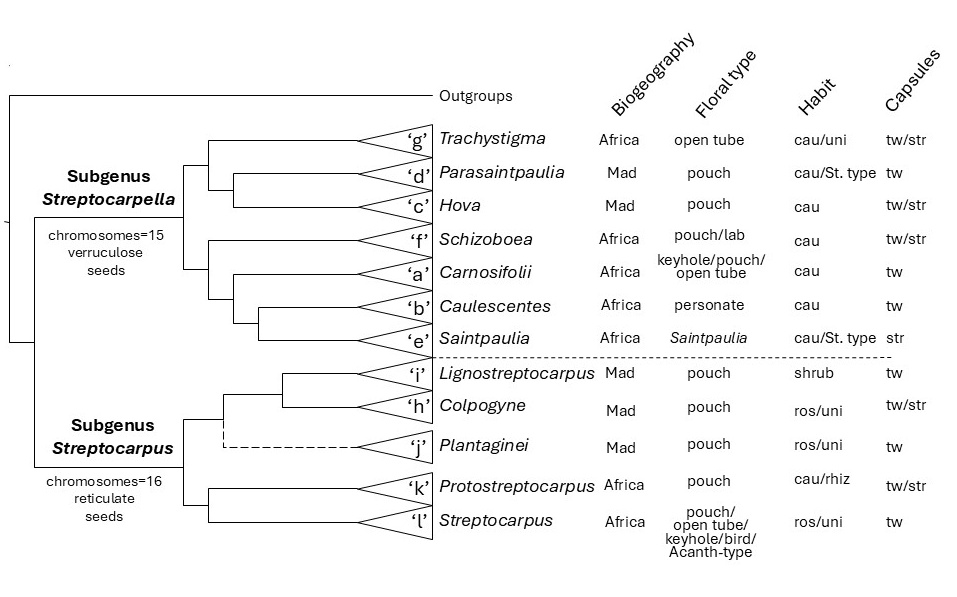
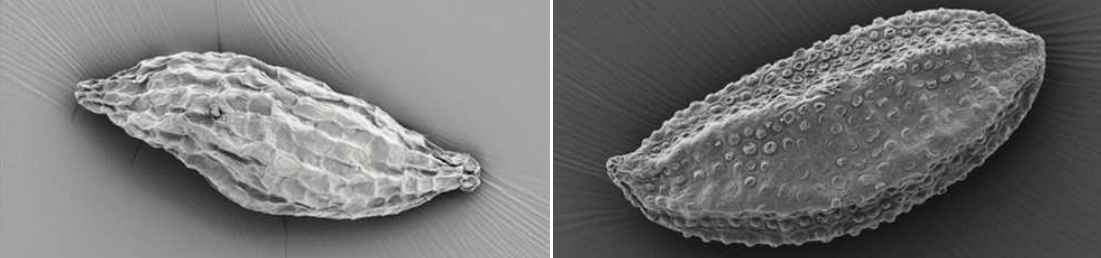
The two subgenera have certain distinctive characteristics. Streptocarpus usually have unifoliate or rosulate leaf structures emerging from the base of the plant, while Streptocarpella species usually have branching stems with conventional leaves. Streptocarpus species largely have reticulate (netted) seeds and 16 chromosomes, whilst Streptocarpella species largely have verruculose (warted/bumpy) seeds and 15 chromosomes. More detailed descriptions of each of the subgenera and their sections are given hereafter. For a full species listing, see Appendix 1.
In the Section pages that follow, species have been placed in Sections based on genetic analyses by Nishii et al (2015), or on morphological grounds as indicated:
* by Nishii et al (2015)
** by the present author, Dirk Bellstedt, based on new species descriptions after 2015