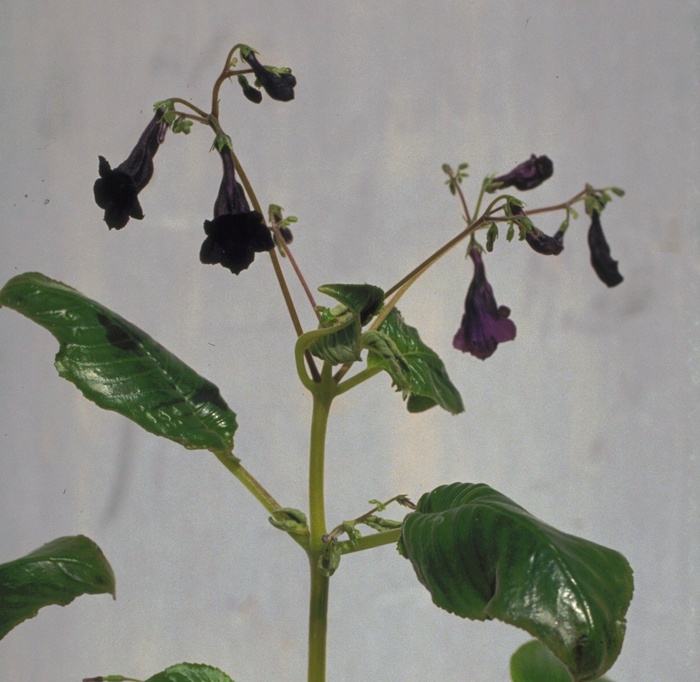
In the older classification of Hilliard & Burtt (1971) subgenus Streptocarpella was primarily defined by its caulescent (herbaceous) growth character. However, in the classification of Nishii et al. (2015) in the redefined subgenus Streptocarpella, most sections still have this growth form, but others such as species in Sections Parasaintpaulia and Saintpaulia are subtly different.
In Sections Parasaintpaulia and Saintpaulia, most of the species have no internodes between leaf nodes. One leaf node follows tightly after the next. However, if one examines the species carefully one sees that there are quite a number of species in which the internodes are in fact stretched out as in the caulescent growth pattern and are not completely shortened. This is found in Streptocarpus watkinsii, S. afriviola, S. inconspicuus, S. goetzeanus and even some of the classic former Saintpaulia species such as Streptocarpus ionanthus subsp. grotei. Similarly, in the Section Parasaintpaulia, the recently described Streptocarpus peltatus has creeping stems and longer internodes. In those species that show no internodes, this reduction in the stem length may be an adaptation to growing on steep cliff faces and slopes where short stems make the plant more compact and less susceptible to wind damage.
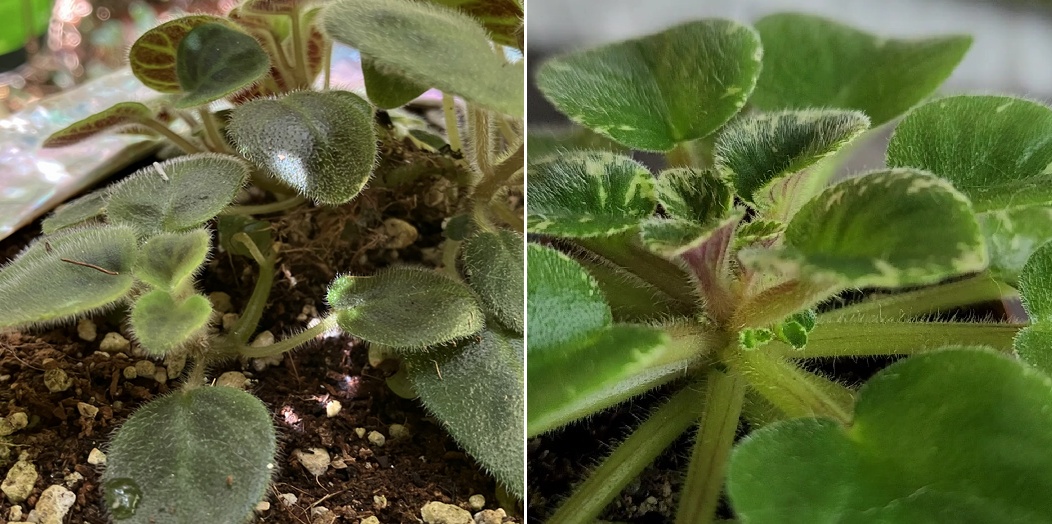
Besides Section Saintpaulia, Section Trachystigma also needs special mention regarding its classification in Section Streptocarpella. It contains species that are unifoliates, as they are found in Section Streptocarpus, but one of these species, Streptocarpus nobilis, gives a good indication of how these species can be accommodated in subgenus Streptocarpella. If the species is grown under drier conditions, its growth is halted at the basal single leaf stage and flowers without making a herbaceous stem and it looks like a typical unifoliate belonging to subgenus Streptocarpus. However, if Streptocarpus nobilis is grown under moister conditions, it develops a single basal leaf and from this a stemmed herbaceous plant develops which is typically like a Streptocarpella. Streptocarpus manni and Streptocarpus strigosus only grow as unifoliates, but the DNA evidence indicates that these species belong in subgenus Streptocarpella.