Gesneriad Genera
In 1861, early days in the botanical exploration of Streptocarpus, Streptocarpus saundersii was described by W.J. Hooker, curator of Kew Botanical Garden, London. Seed had been sent from the new English colony of Natal (now KwaZulu Natal Province of South Africa) in 1860 to Mr. W. W. Saunders of Reigate, Surrey, England, and it was grown at Kew where the charming little plant immediately attracted horticultural attention (see a botanical print). Although used to produce hybrids then, these did not end up in subsequent hybridization programs. With its attractive corolla colour and yellow throat markings, this is a species that should be re-introduced into hybridization programs followed by careful selection.
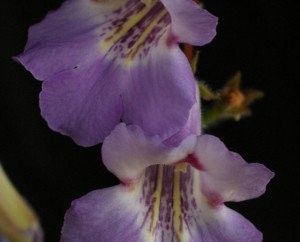
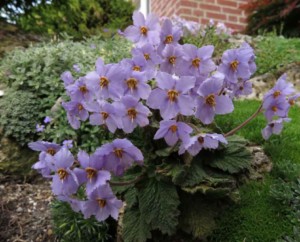
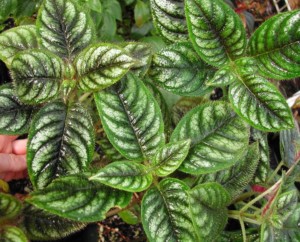
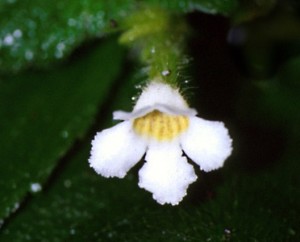
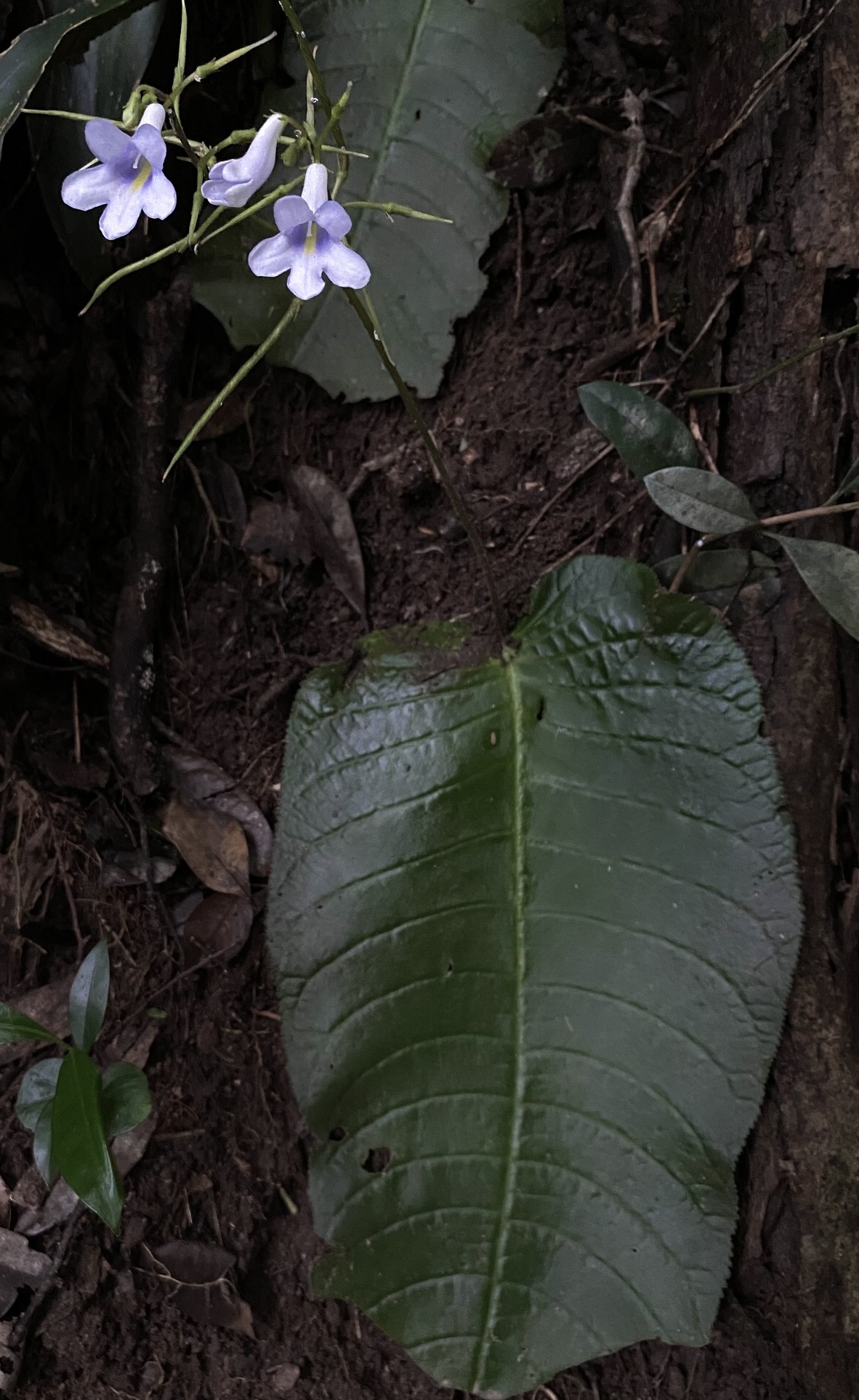
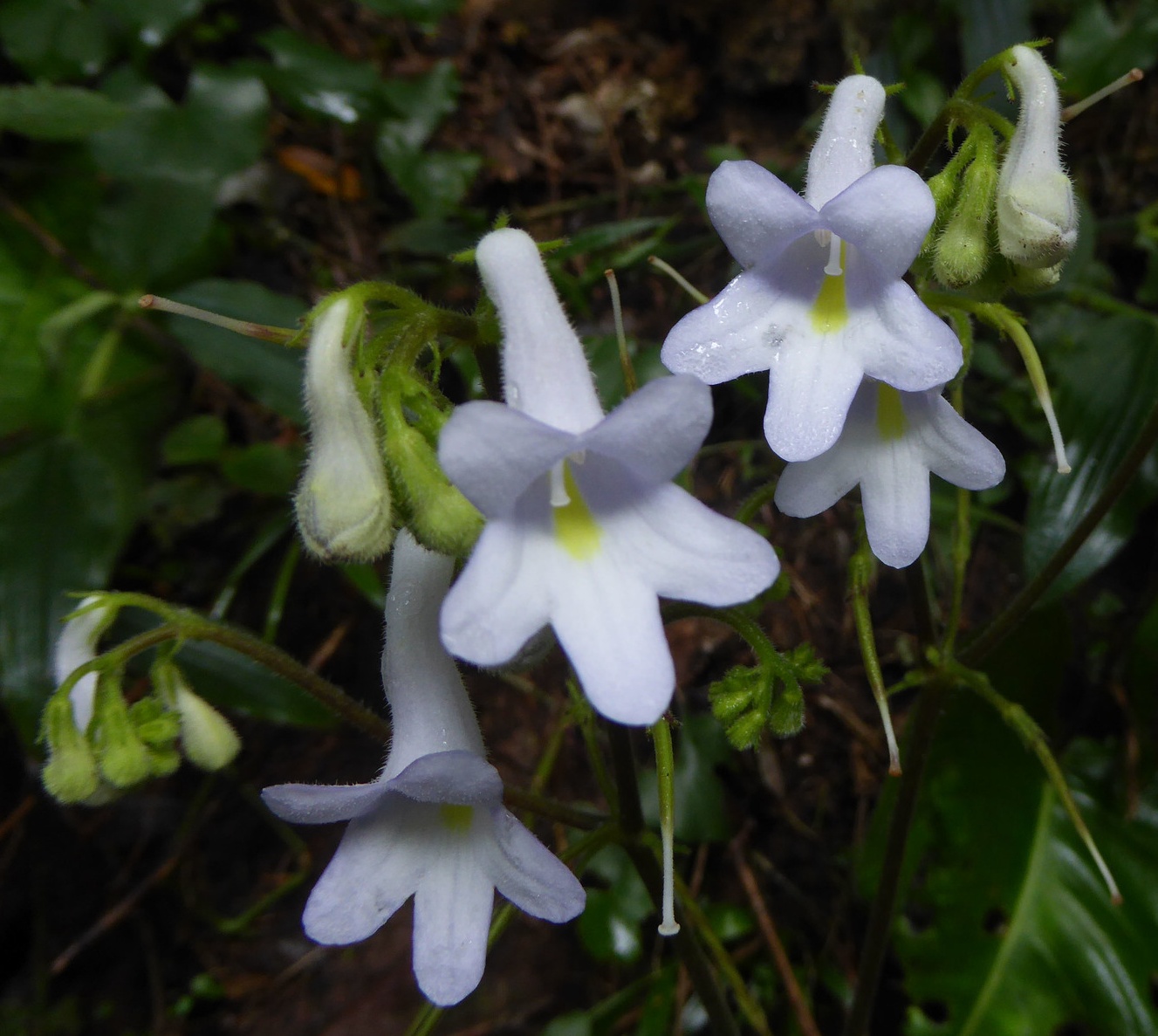
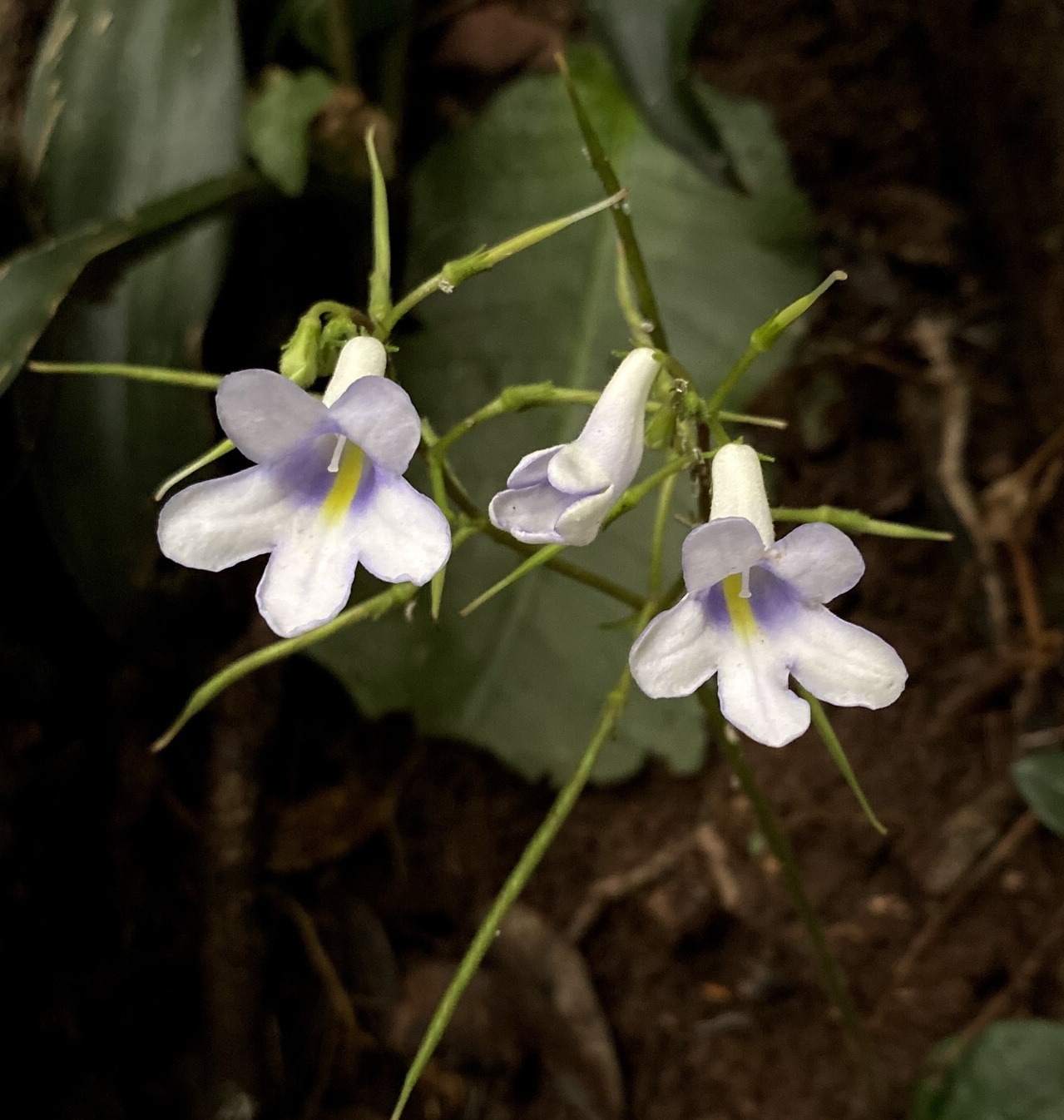
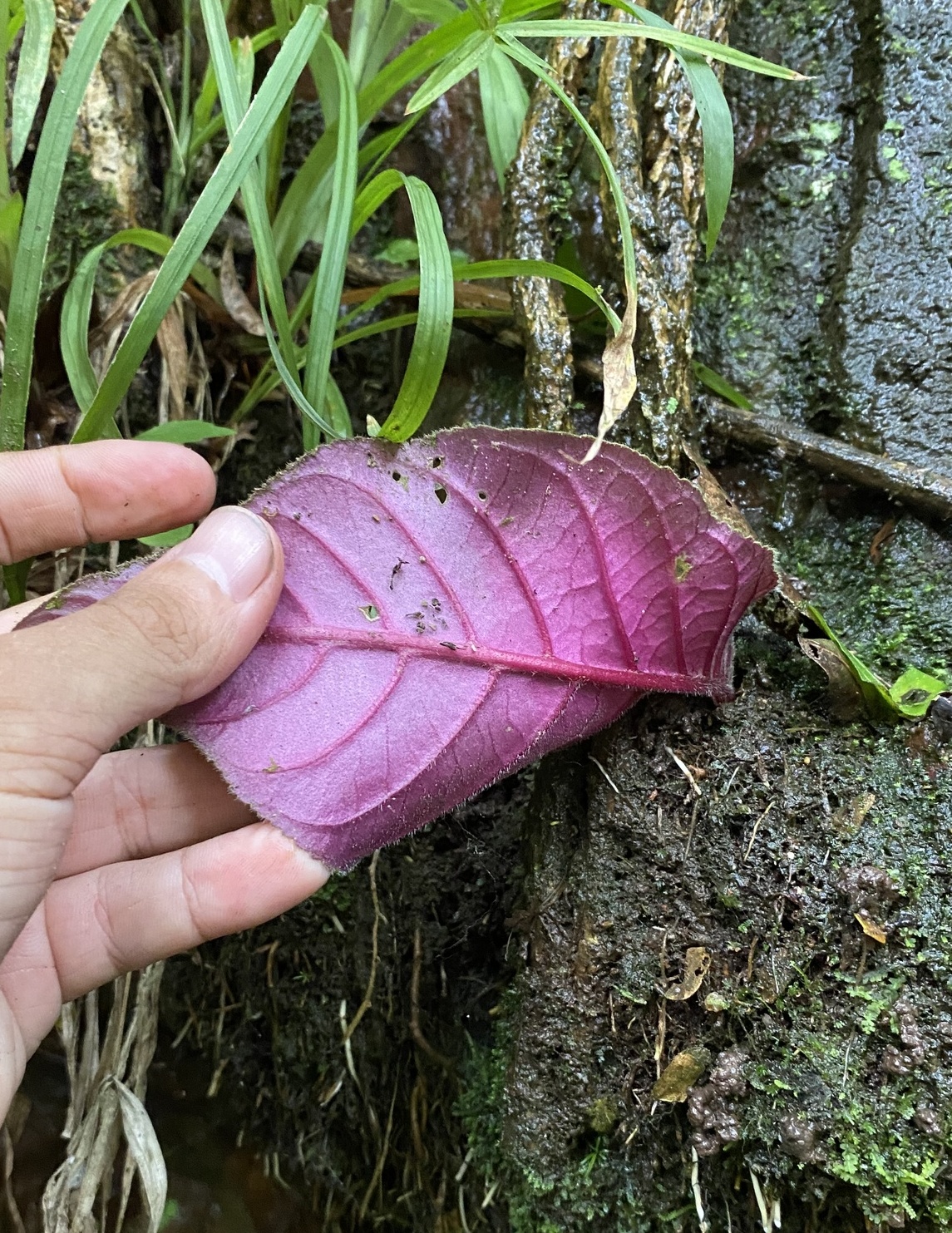
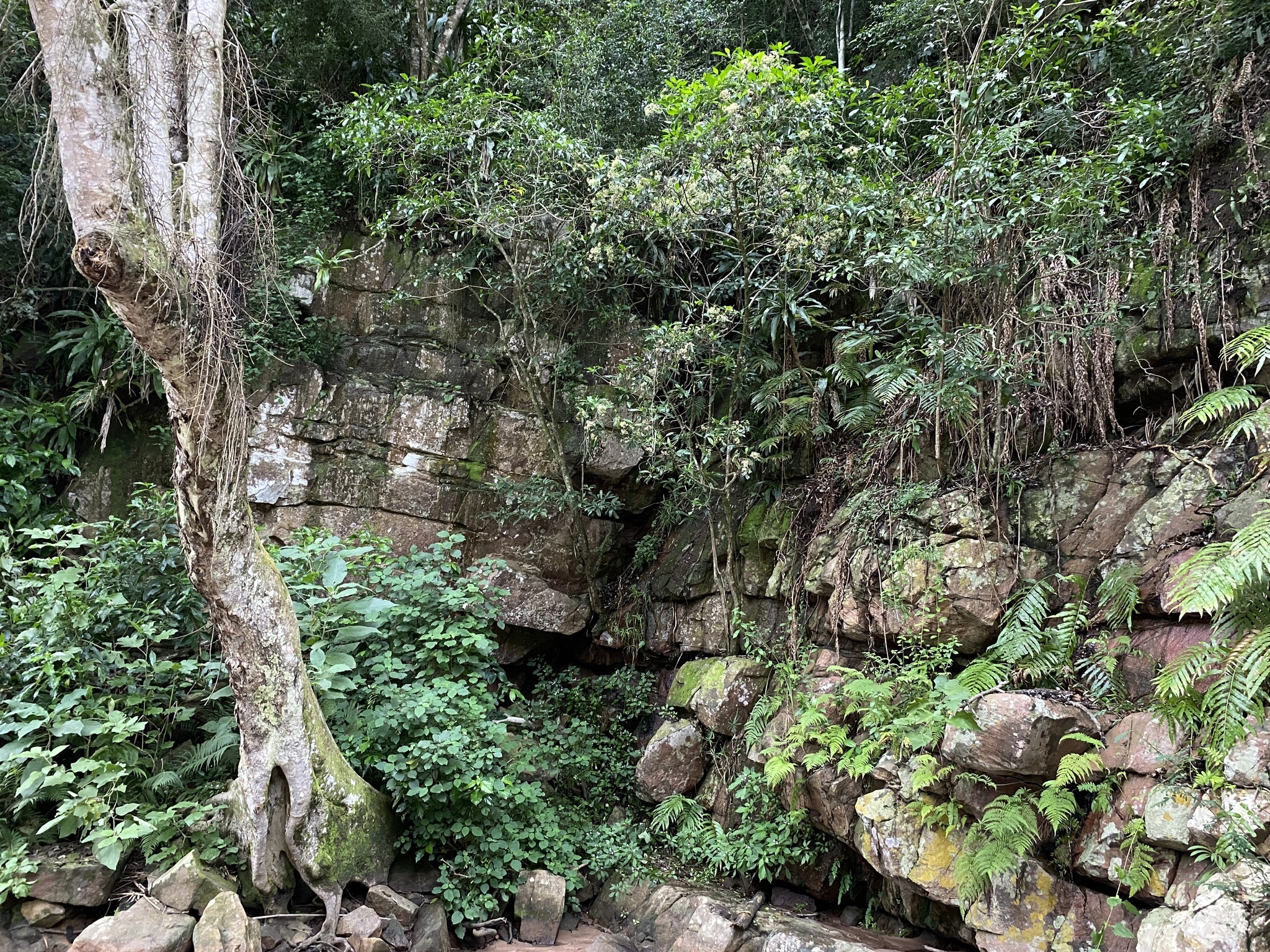
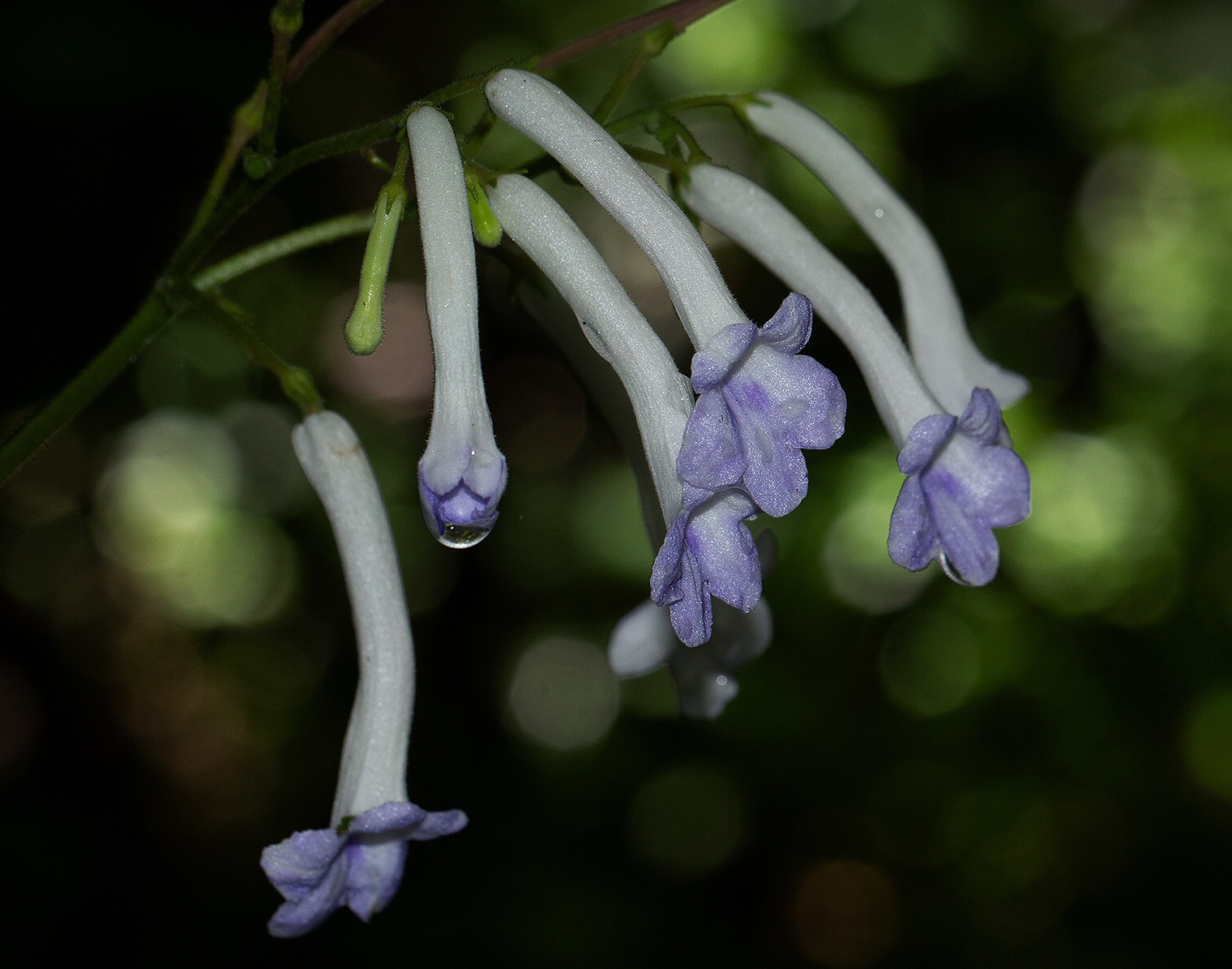
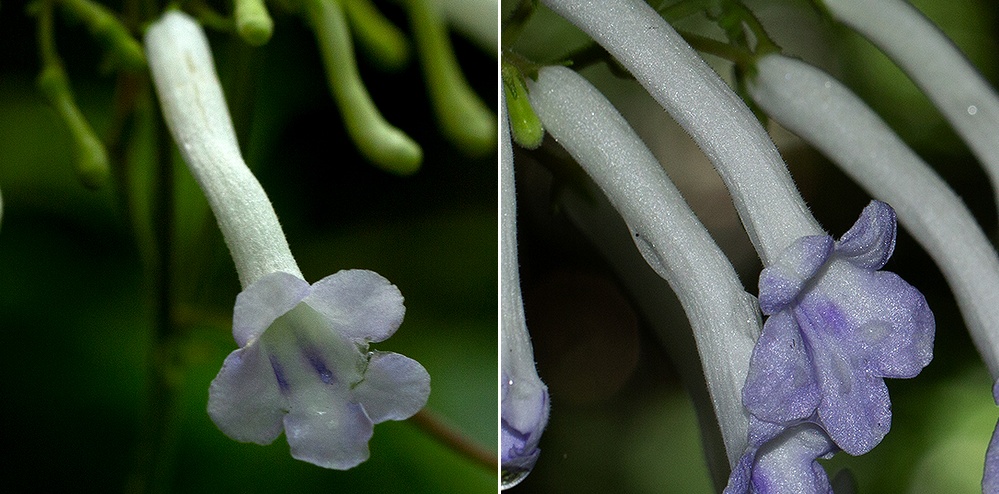
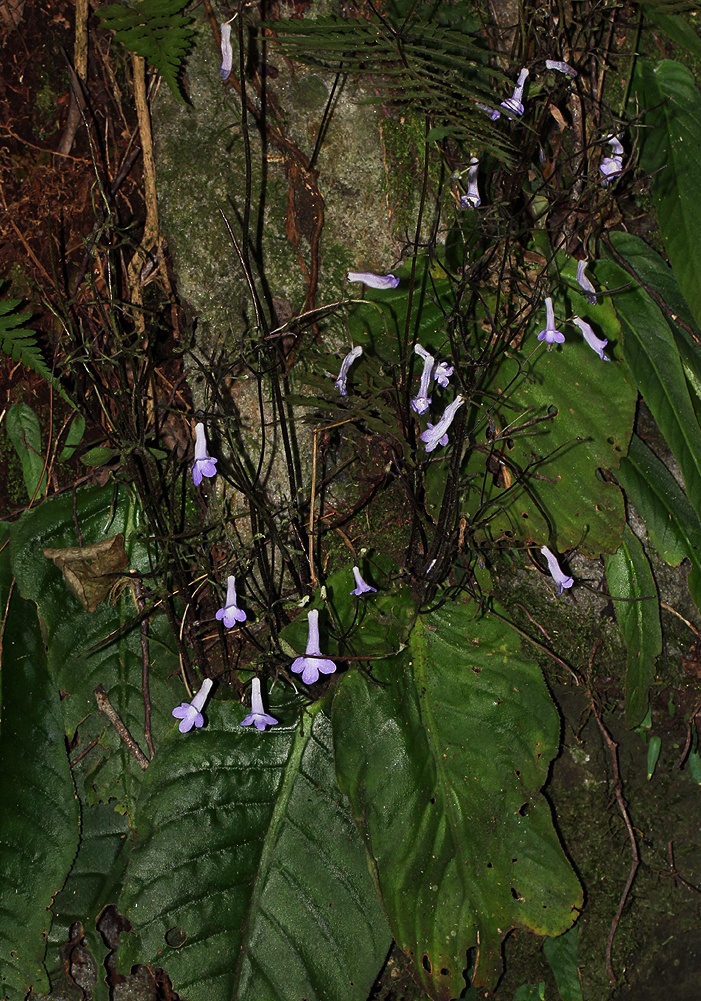
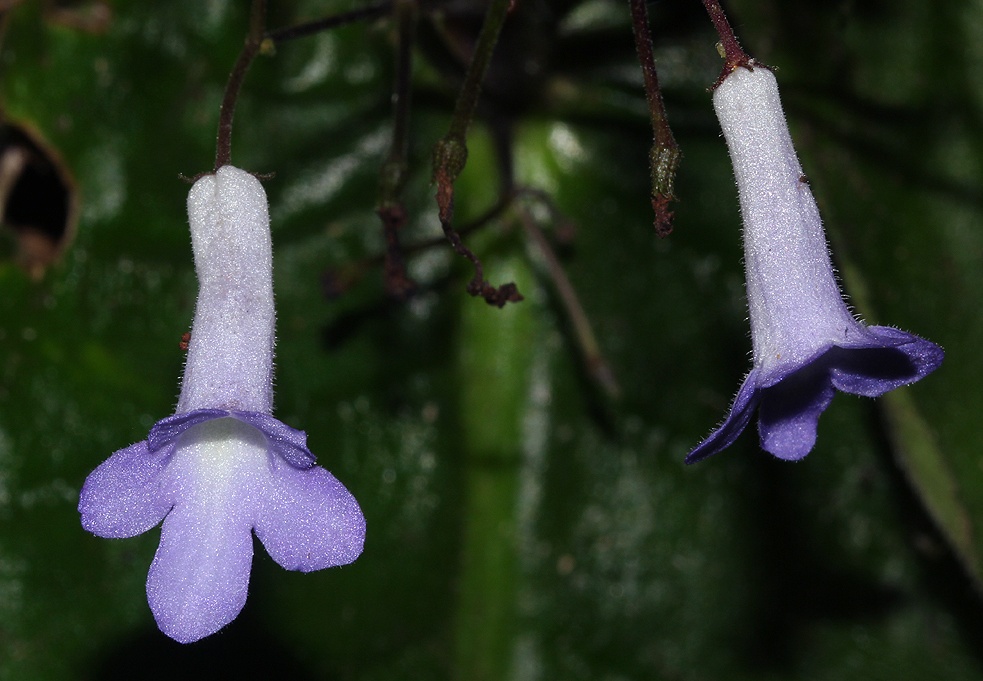
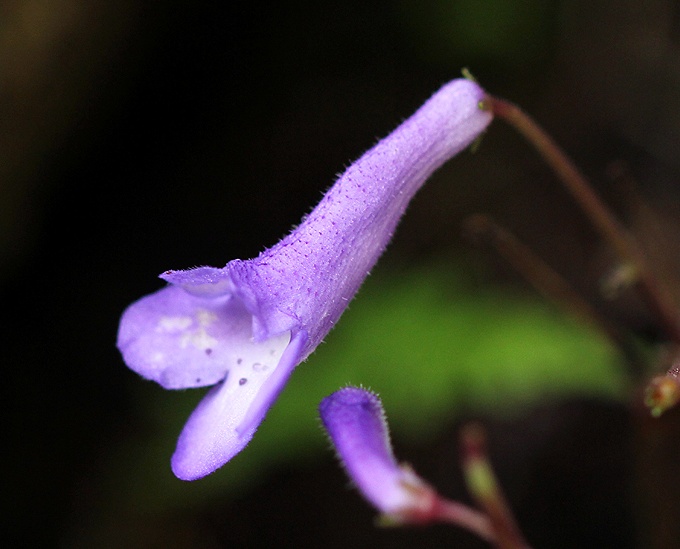
Streptocarpus saundersii is a monocarpic unifoliate with a fairly large (370 x 260 mm), dark green leaf, underside often beetroot red. It produces numerous flowers, many opening at the same time to give an attractive floral display. The flowers are tube shaped, variable in length (26 – 40 mm), and colour (white to pale violet) with darker violet on the bottom of the corolla floor with a long conspicuous yellow stripe. It grows on moss covered rocks or steep embankments in forest, from Inanda inland from the coastal city of Durban towards Pietermaritzburg to Nkandla in the north (KwaZulu Natal Province, South Africa).
- A plant with flowers, growing on a steep bank
- A close view of pale, almost white, flowers
- Another close view of flowers, these with lavender shading and markings, and yellow in the throat
- The red-backed leaf
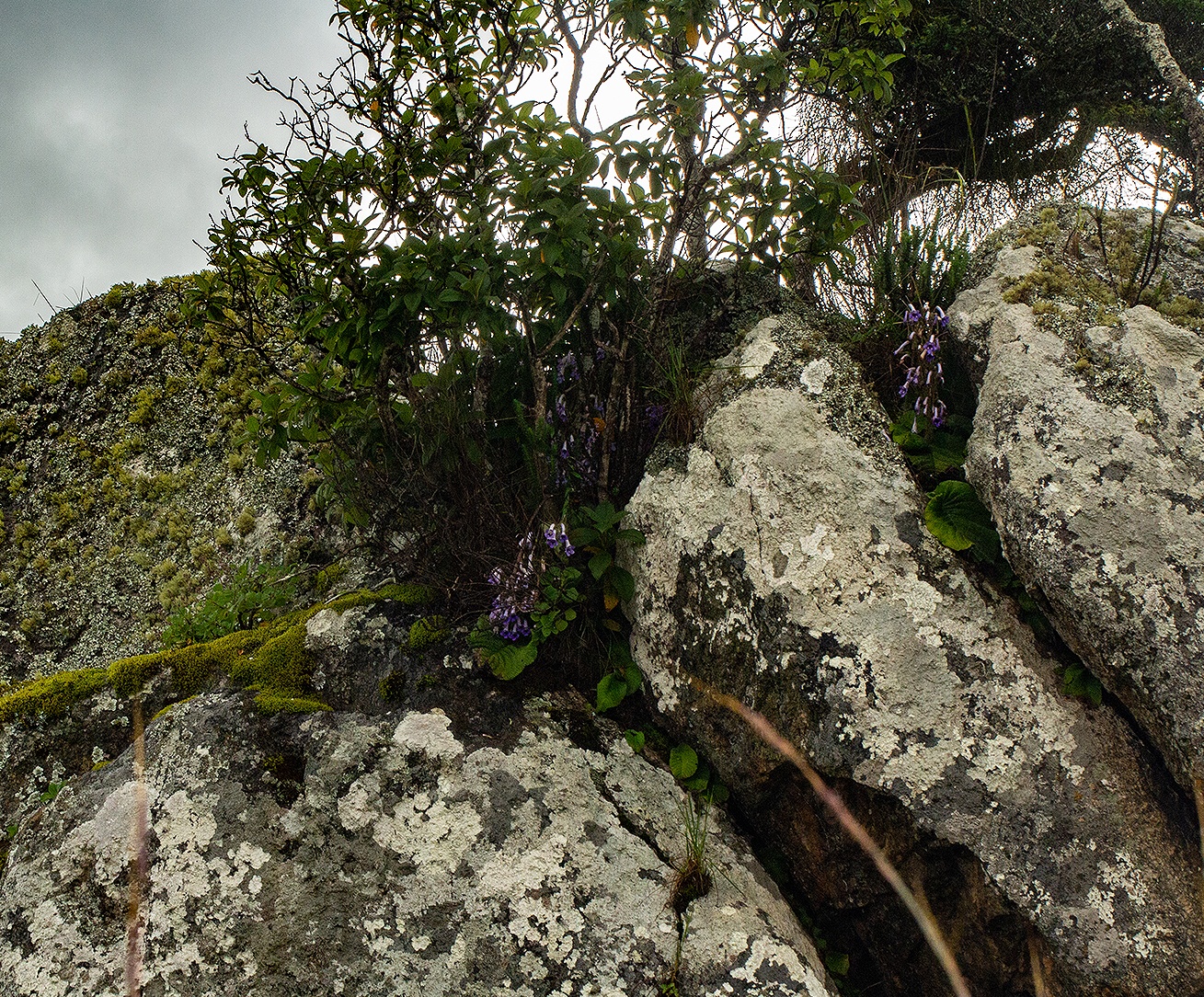
- Typical habitat for the species; there are small plants visible, if you look really hard
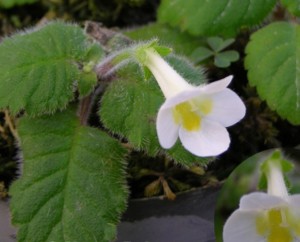
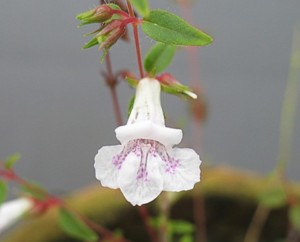
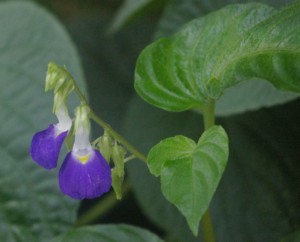
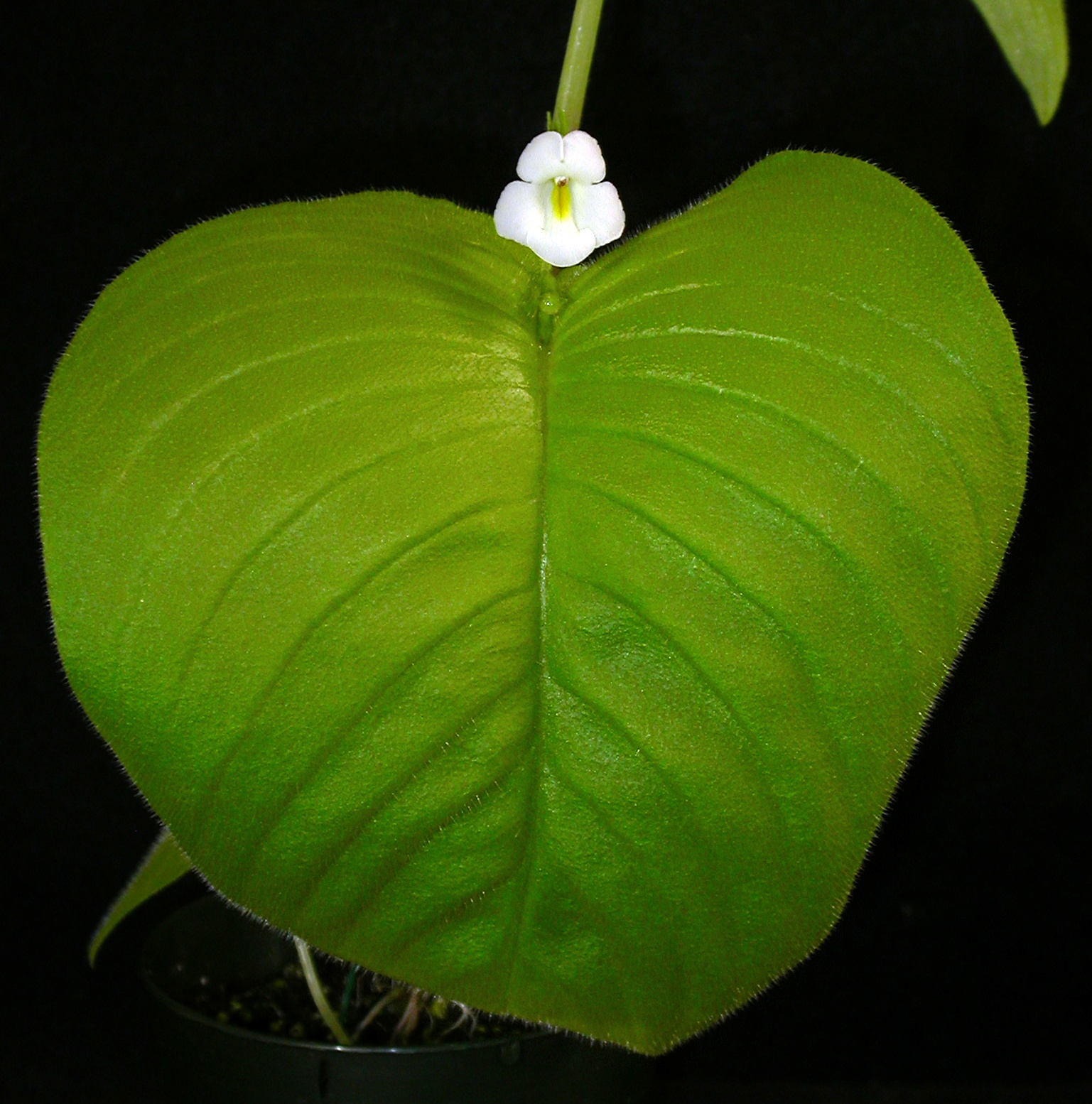
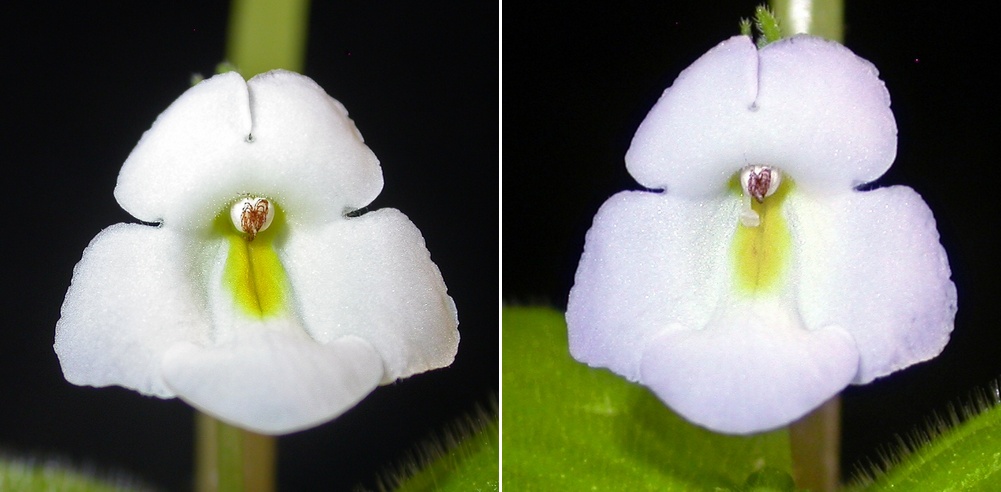
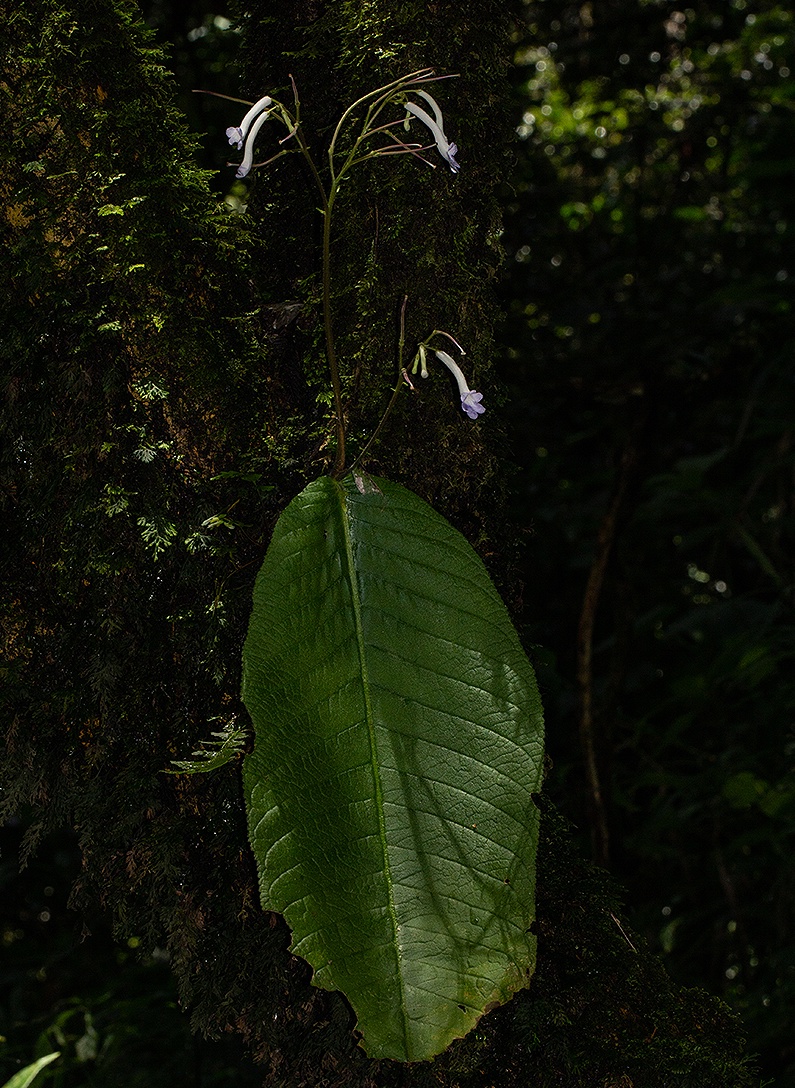
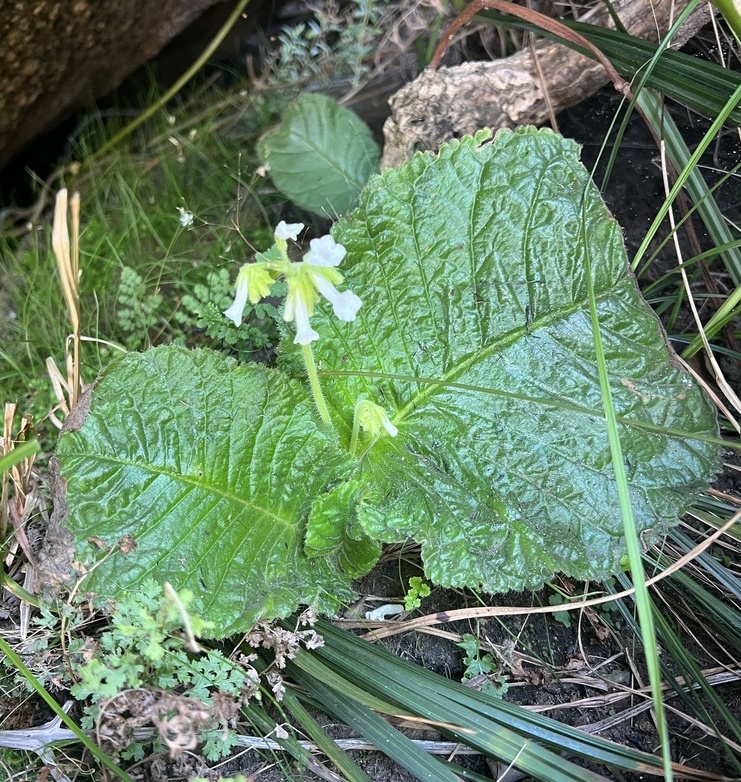
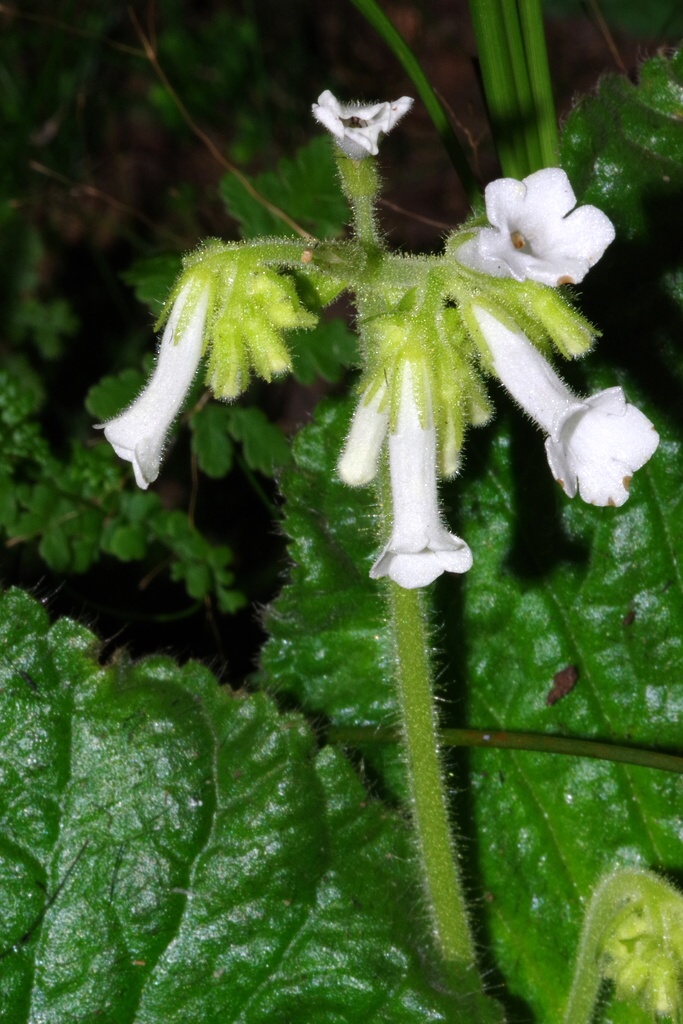
Microchirita formosa is an upright shrub found in the northern karst regions of Thailand, one of about 37 Microchirita species in that country. The flower has a white corolla with two dorsal yellow stripes, and is similar overall to that of M. candida. M. formosa is distinguished from M. candida by longer hairs on anthers and ovary. Leaves are dull green above and pale green underneath with an entire margin.
Described in 2023, this species has been cultivated from seed, which is typical for the likely short-lived Michrochirita species.
In cultivation it can reach a height of 65 cm or more and thus requires significant space or regular re-starts from seed or vegetative propagation.
- A close view of the large leaf and flower
- The same flower, with photos taken a day apart; note the pale lavender color of the older flower
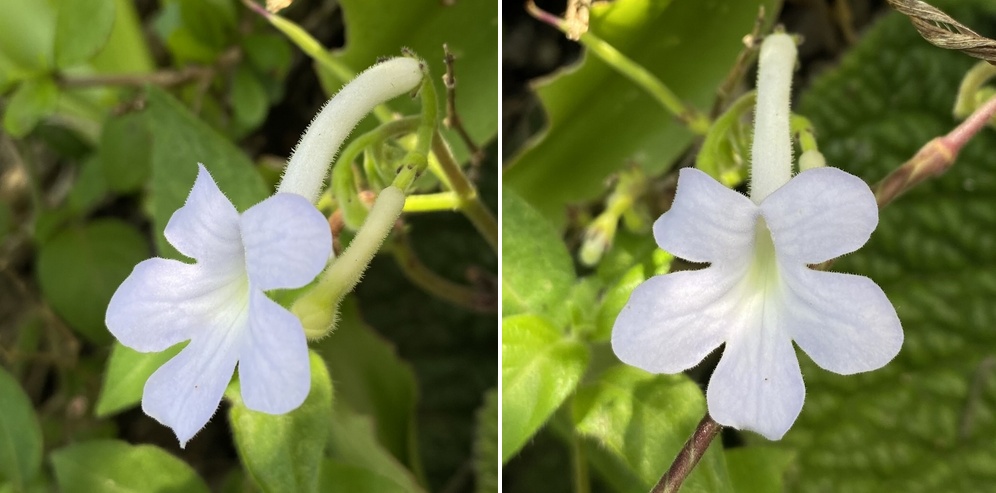
Streptocarpus confusus was originally described by Olive Hilliard in 1966 in an effort to separate it from Streptocarpus haygarthii to which it is closely related, hence also its name referring to the confusion between the two species. A distinctive characteristic of the Streptocarpus confusus flower is the way the two upper corolla lobes are positioned relative to each other. Instead of the all five of the lobes pointing outwards evenly from the centre of the flower, the two upper lobes are positioned in such a way that they almost lie opposite each other. This results in a tight vertical narrowing of the opening of the corolla tube.
In 1968, Hilliard and Burtt described Streptocarpus confusus ssp. lebomboensis to separate a long flowered form from the originally described short flowered form of the species. Both subspecies are apparently more drought resistant, and therefore able to occupy habitats that other Streptocarpus species cannot grow in. Both subspecies of Streptocarpus confusus are monocarpic and unifoliate with leaf dimensions up to 300 x 170 mm.
The range of Streptocarpus confusus ssp. lebomboensis is different than that of S. confusus ssp. confusus, and it occurs more easterly from northern KwaZulu Natal Province, South Africa, into Eswatini and Mozambique. The name of the subspecies derives from the Lebombo Mountains where is grows in semi-shade often on very exposed cliffs and rock faces, which are covered in otherwise succulent vegetation. Streptocarpus confusus ssp. lebomboensis has larger pale mauve keyhole shaped flowers (c. 35 – 55 mm long) and has a forked stigma.
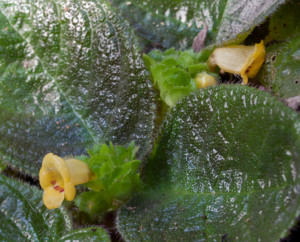
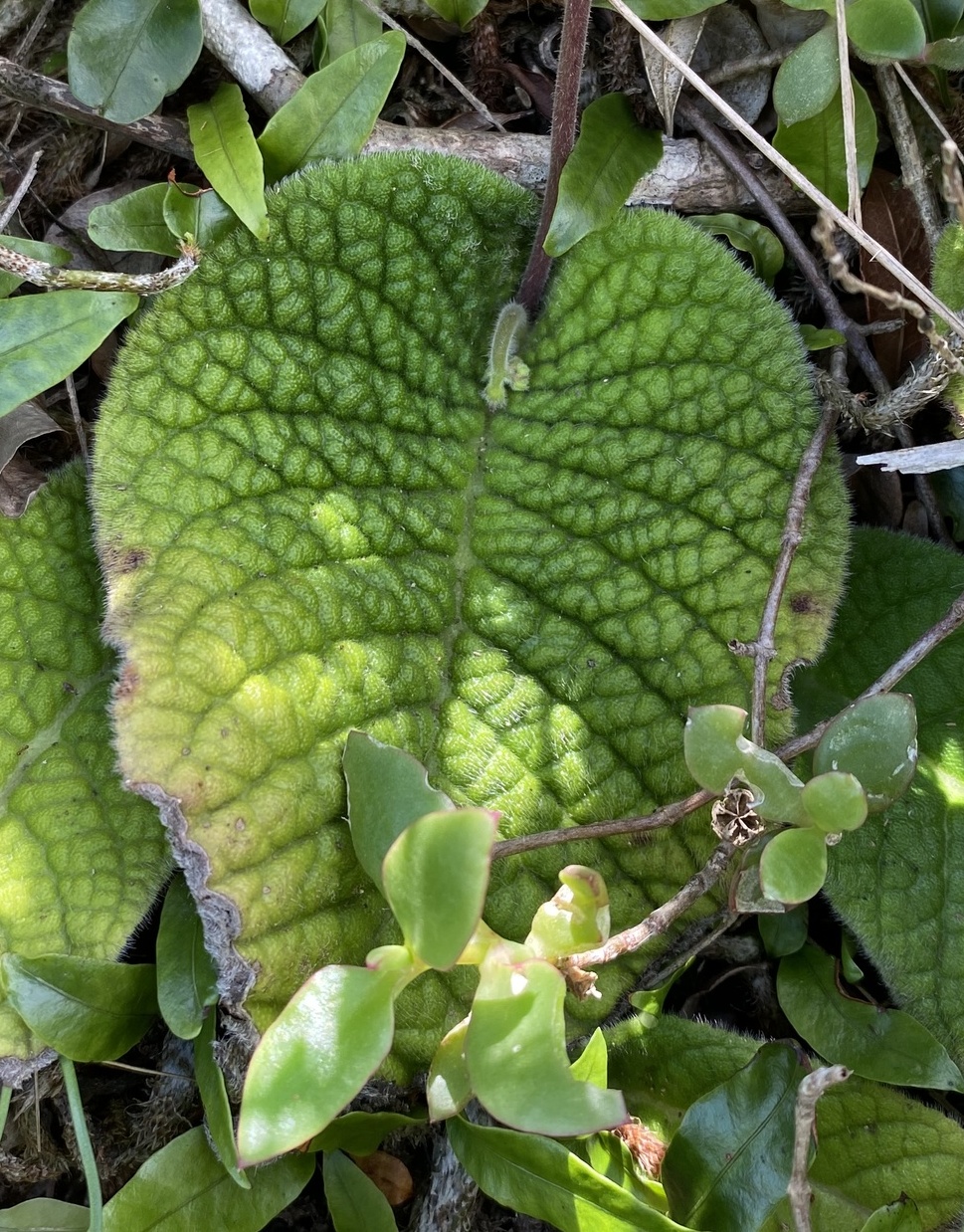
This form of the species is usually seen with very bullate leaves, as can be seen in the photos. The plants often grow on west-facing cliffs which bake in the afternoon sun, surrounded by drought resistant succulents. The bullate character of the leaves is thought to provide a defense against moisture loss for these drought tolerant plants.
- A robust and bullate leaf
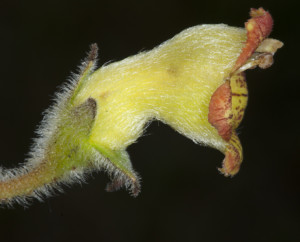
- A composite image of a flower, showing both a profile and front view, illustrating the curved corolla tube and the keyhole opening in the corolla
Although Streptocarpus breviflos appears on all lists of Streptocarpus species in the World Floras, it is probably not a valid species.
It was described in 1904 by C.B Clarke (see botanical history) after he originally named it Streptocarpus saundersii var. breviflos. “Breviflos” means short flower so this perhaps refers to a short flowered variety of Strepocarpus saundersii. While reported to be native to Free State Province of South Africa there are virtually no locations within that Province that have habitat suitable for Streptocarpus species, it being largely hot and dry. Aside from the original publication there is no botanical record of S. breviflos – no herbarium specimen, no collections, no photographs, no drawings and no sighting reports at all. Hilliard and Burtt, in Streptocarpus – An African Plant Study (1971), include it in their list of “Excluded and doubtful names”, and address the doubtful legitimacy of the species in their comments (page 374).
Streptocarpus rhodesianus is a species that has two subspecies based on morphological differences and on geographic distribution as the ranges of the two subspecies do not overlap.
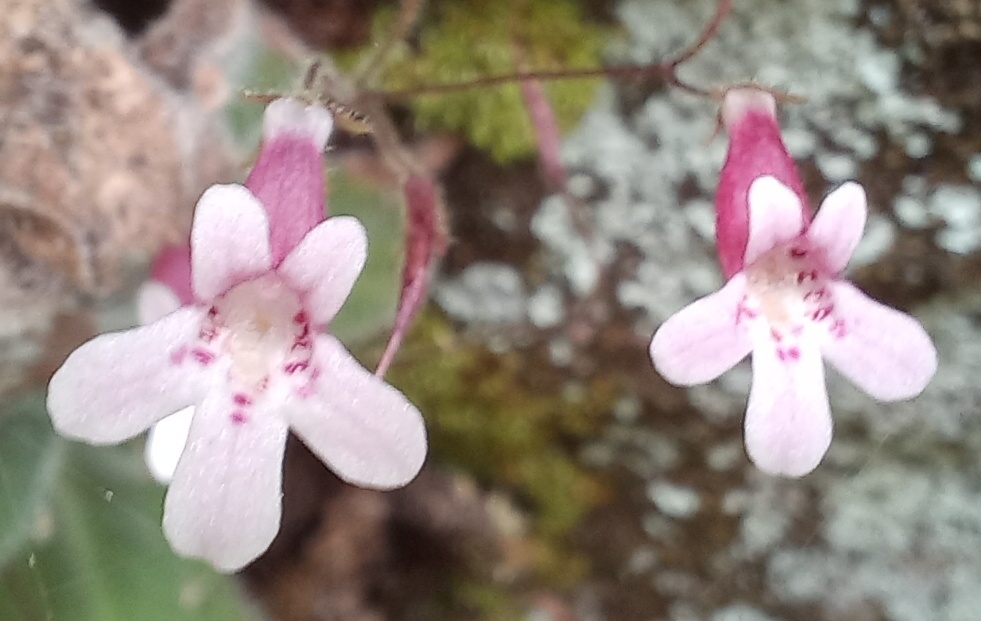
Streptocarpus rhodesianus ssp. rhodesianus occurs in Zambia, the Katanga Province of the Congo and eastern Moxico Province of Angola. Its grows in the shelter of outcrops on moss and lichen covered rocks and on mountainsides. Its rosette of leaves (up to 200 x 190 mm, mostly smaller) has a flannely, greyish green appearance and the plant appears to have good drought resistance if gauged by the glandular hairs found on its leaves, stems and flowers. These hairs allow the capture of moisture from mists and clouds. The flowers are small (7-10 mm long), dull purple to wine red with the inside of the corolla lobes white with wine red blotches and two rows of hairs on the lower corolla tube. The hairiness reminds one of the Angolan species, Streptocarpus huamboensis which also has hairs all over the plant.
Streptocarpus rhodesianus ssp. grandiflorus is described in the Flora of East Africa from southern Tanzania where it also occurs on rocky outcrops. It is described as having larger white flowers, but few details or pictures are available.
Streptocarpus erubescens is a monocarpic, unifoliate species from high altitude areas in central to southern Malawi extending into western Mozambique where it grows on mossy rocks in evergreen forest and in rock crevices under overhangs. It is even reported to grow on hills within the municipal limits of cities such as Blantyre and Zomba in Malawi.
Its single leaf (150 x 120 mm maximum) is dark green above, red below with serrated edges. The flowers are white with pink tones, with three magenta-pink stripes inside. The species is very similar to Streptocarpus cyanandrus and Streptocarpus pumilus from Zimbabwe, and DNA analysis confirms this close relationship.
Despite it’s wide distribution, one-time presence in cultivation and use in hybridizing we could find no pictures of this species, hence the hopefully temporary use of the herbarium sheet above, with the ruler for scale.
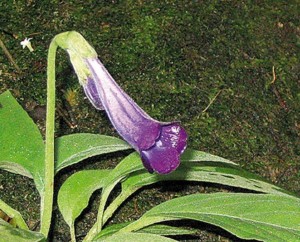
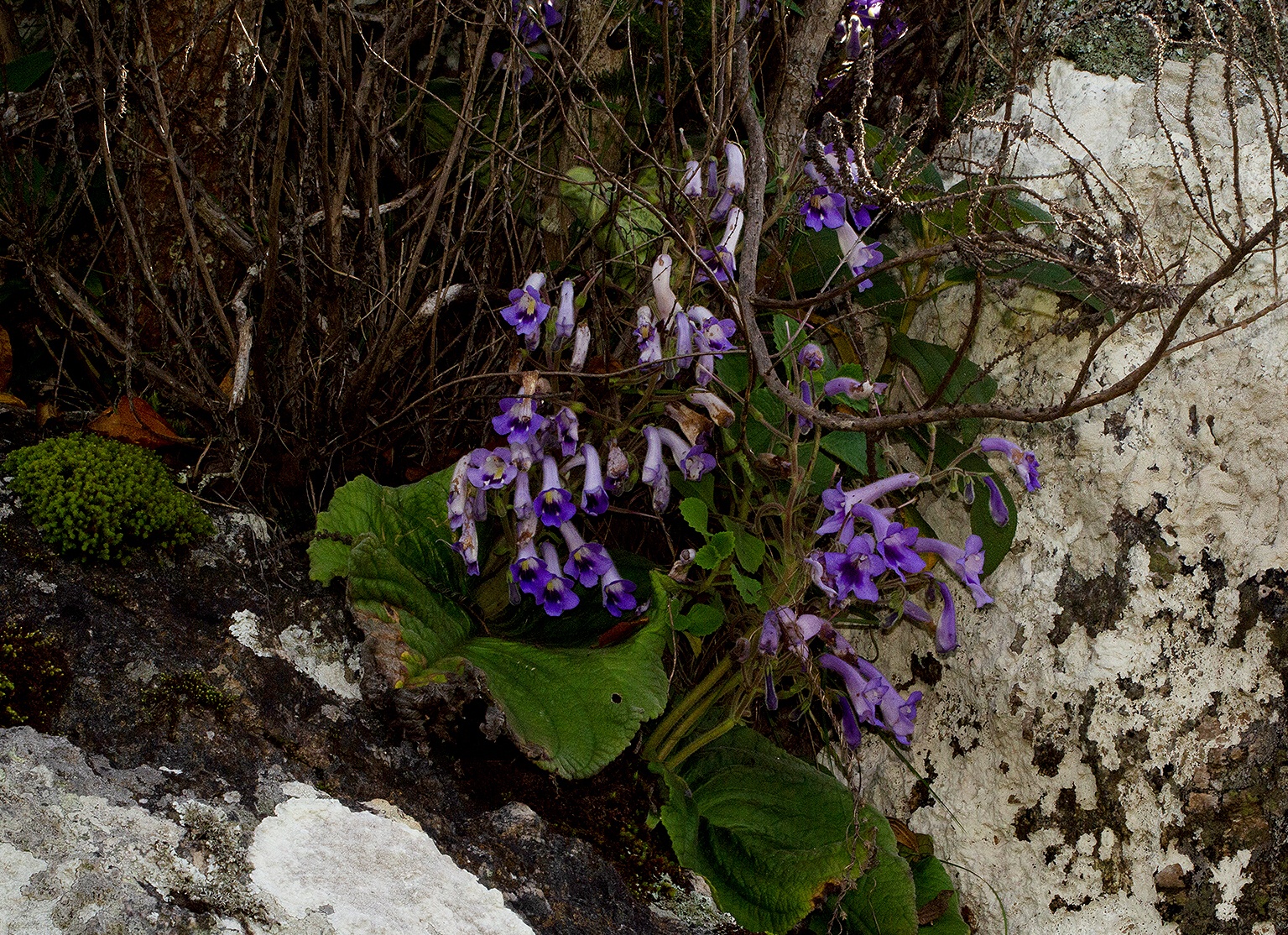
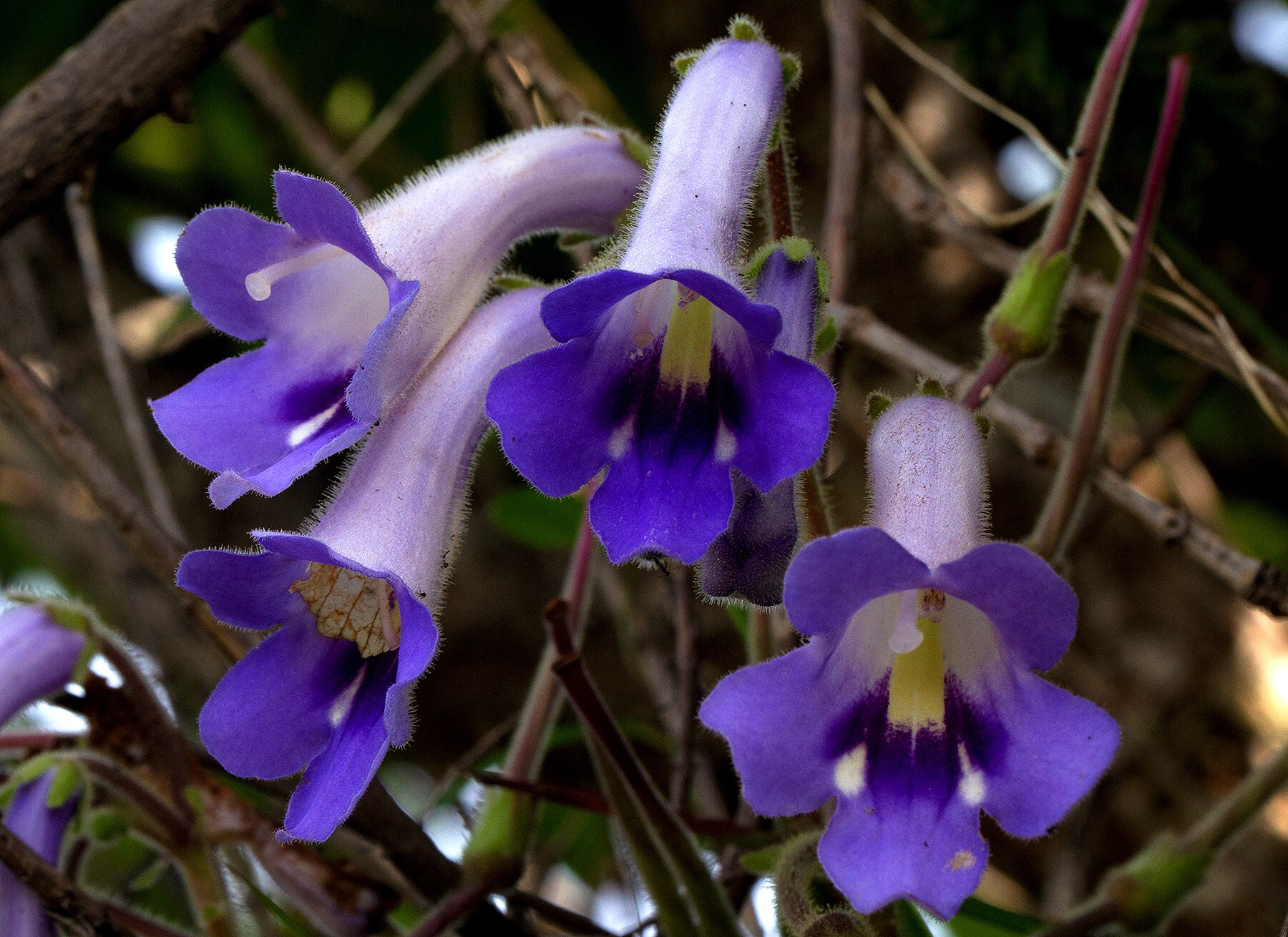
Streptocarpus wittei (pronounce the “w” as a “v”) occurs in the vicinity of Lukafu in gorges draining the Kundulungu Plateau north of Lubumbashi, Katanga Province, south eastern Congo, and then again with a significant disjunction (about 700 km) near Chowo on the Nyika Plateau on the border between northern Zambia and Malawi. It is a large monocarpic, unifoliate species, leaf about 250 x 280 mm, with many large flowers (50 – 60 mm) per inflorescence, dark violet with darker violet and yellow throat markings. It habitat is likely to be forest in the Lukafu vicinity but on the Nyika Plateau it occurs on rocky outcrops. More fieldwork is required to compare the morphology and DNA sequences of the two isolated populations to establish whether this species should be split into two.
- Heavily flowering plants growing amongst rocks
- A close view of the beautiful flowers
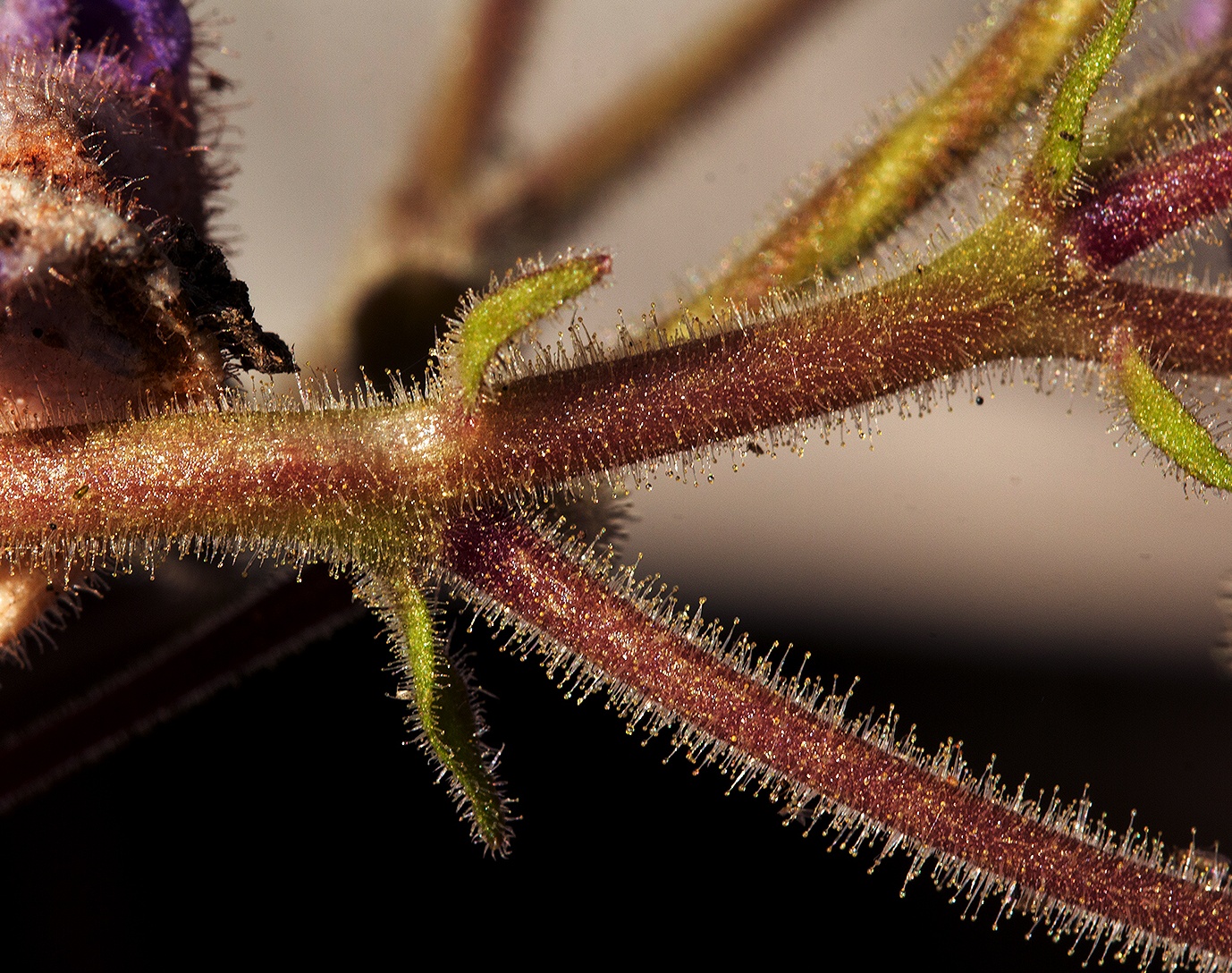
- The inflorescence stems with dense glandular trichomes (hairs), which probably make these stems sticky
- The habitat of S. wittei, in very well drained clefts between giant boulders
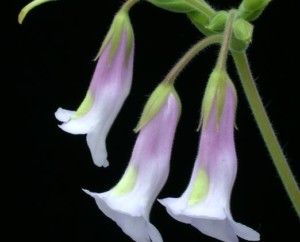
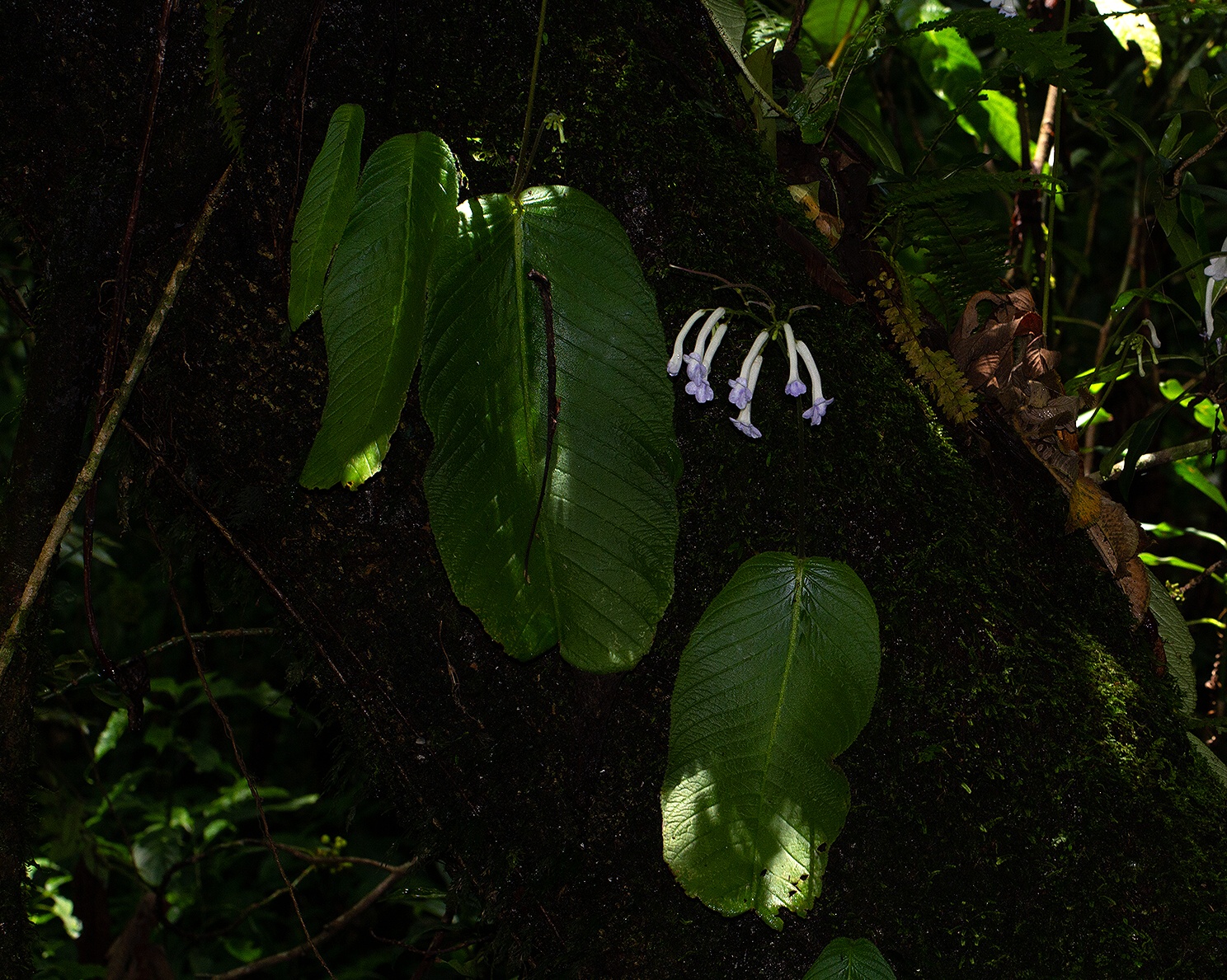
Streptocarpus solenanthus occurs over a wide range from the Manica Highlands on the Zimbabwe Mozambique border, to the Nyika Plateau in Zambia and Malawi, the Vipya Plateau in Malawi, the mountains at the northern end of Lake Malawi and even as far as the Uluguru Mountains in the Eastern Arc mountains, inland of Dar-es-Salaam, in Tanzania. It is a monocarpic, unifoliate species (leaf 350 x 70 mm) and grows both in forest and on rock outcrops. The corolla (22-36 mm) is whitish to pale violet, often with darker violet patches in the throat. With such a huge range more fieldwork is required to better define this species.
- A single plant, illustrating how the single leaf hangs down on steep surfaces like this mossy tree
- A colony of plants on a mossy tree trunk
- A close view of a flower cluster
- A composite photo illustrating a small part of the range of flower color and markings
Streptocarpus grandis ssp. septentrionalis was originally described from the Chimanimani District, in the eastern Manica Highlands of Zimbabwe but also occurs in Mozambique. It differs from its sister subspecies, Streptocarpus grandis ssp. grandis, by differences in the hairs on the ovary and in having fewer glandular hairs on the inflorescence, has a pale violet to almost white corolla with no throat markings and overall has smaller leaves and flowers.
It occurs some 1000 km away for its sister subspecies. DNA analysis has not been performed on this subspecies (as indicated by the * in the Section species listing) and further comparisons of the two subspecies’ morphology and DNA may indicate that it is a separate species and not only a subspecies.
- An array of plants growing on a near vertical bank, with single leaves hanging down
- A close view of plain lavender flowers
- A side view of the flower, with some spotting.
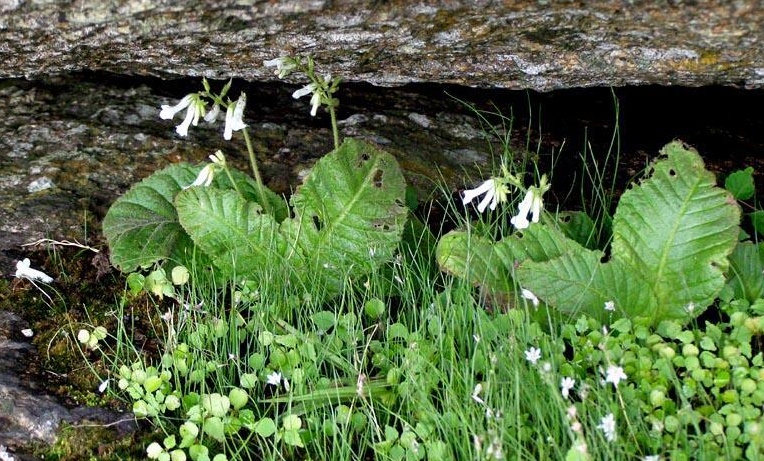
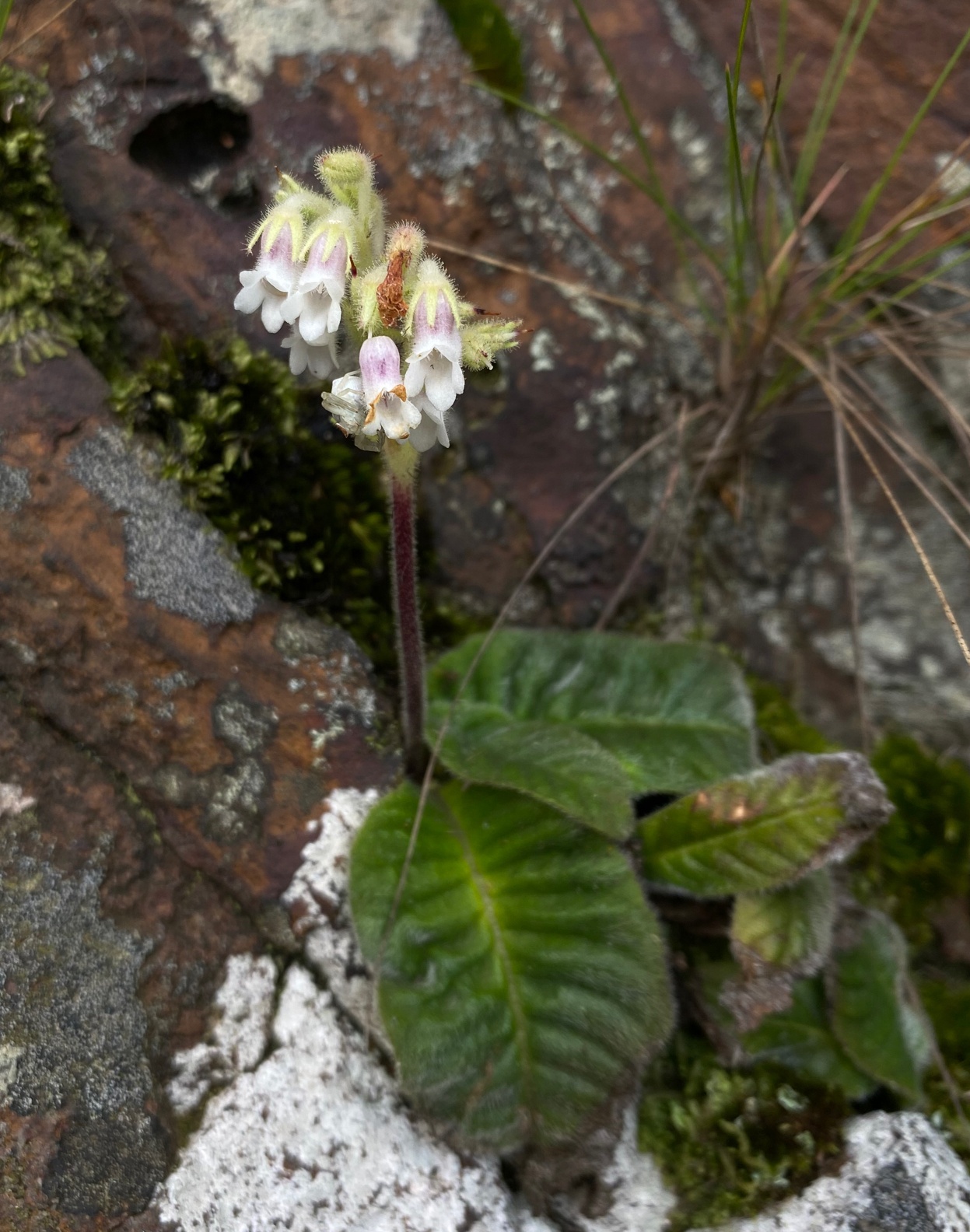
Streptocarpus davyi is a medium sized, rosulate, perennial species, which has a very restricted distribution within an approximately 40 km radius of Mbabane, the capital of Eswatini (former Swaziland). The species occurs under and in the shade of huge granite boulders. It has medium to light green leaves that are maximally 60 x 10 mm with a short stalk (petiolode). The whole plant has lots of hairs to catch moisture from mists.
The flowers are 15 – 20 mm long, most are white, sometimes very pale violet, and sometimes there is a yellow patch further down the corolla tube where the stamens are attached. It has not attracted much horticultural interest, but is a charming little plant that may attract the specialist and the hybridizer because it is smaller.
- Another nice plant
- A close view of an inflorescence
- A colony growing in the shelter of a rock overhang
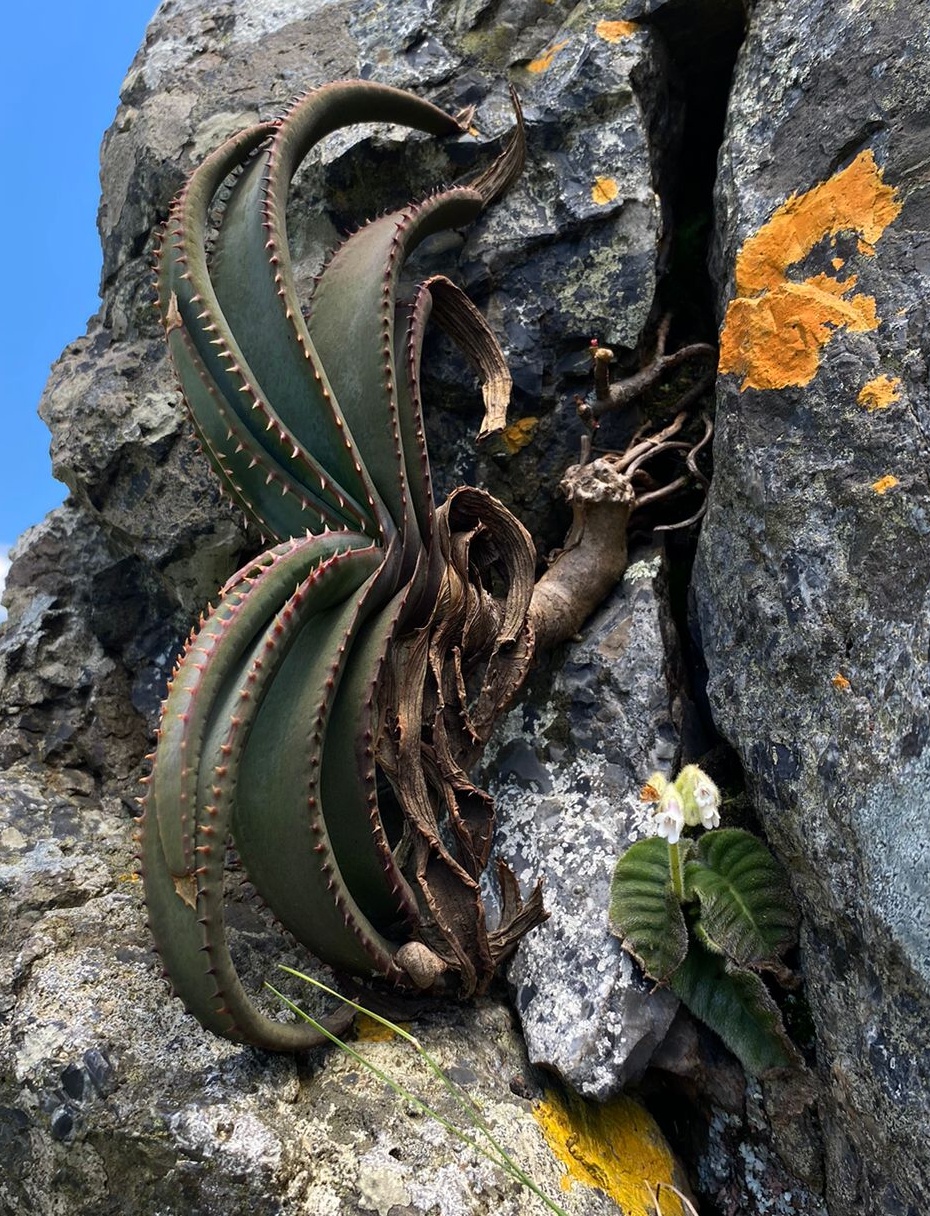
Streptocarpus pogonites occurs in the high altitude area near Barberton in Mpumalanga, South Africa which is near the border to Eswatini (former Swaziland). Higher altitude always implies cooler temperatures and therefore more moderate conditions, but Streptocarpus pogonites grows in very exposed sites where even the milder high altitude does not make the conditions under which it grows less extreme.
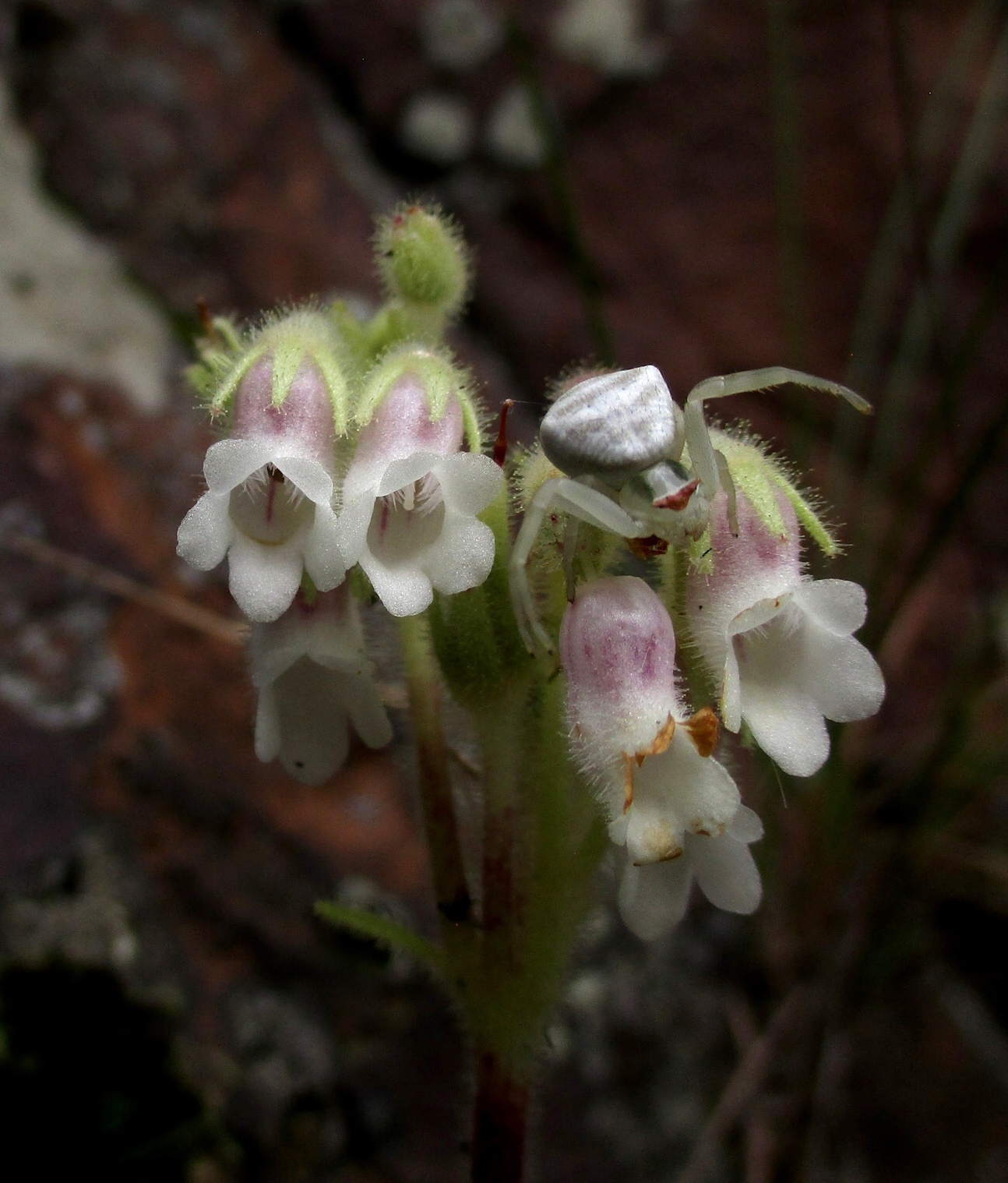
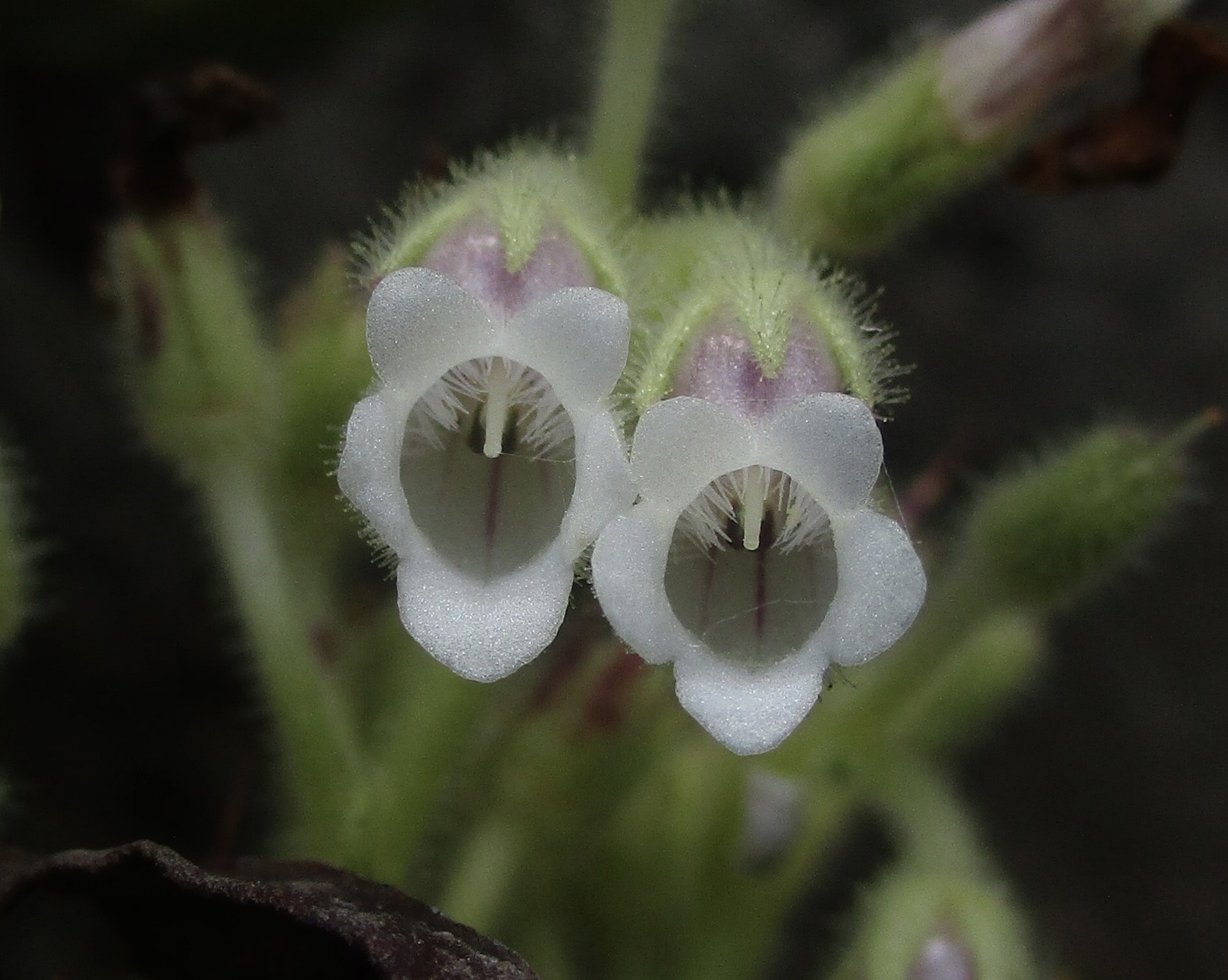
As the pictures show, it grows close to succulent aloes, that are extremely drought tolerant. It has up to five leaves (130 x 55 mm) and is a typical small rosulate species. Leaf, all stalks and flowers are covered in hairs to reduce moisture loss and to capture moisture from high altitude mists. Its flowers are short (corolla 9-10 mm) with very reduced corolla lobes and are pale creamy white with reddish-violet stripes on the corolla base. This species could be an interesting horticultural subject, but it’s unusual natural environment may make it difficult. In any event, it is not in cultivation at present.
- A whole plant with flowers
- Growing next to a large Aloe on a rock slope
- A close view of the flowers with a spider on board
- The front view of the flowers, showing the prominent hairs on the roof of the corolla
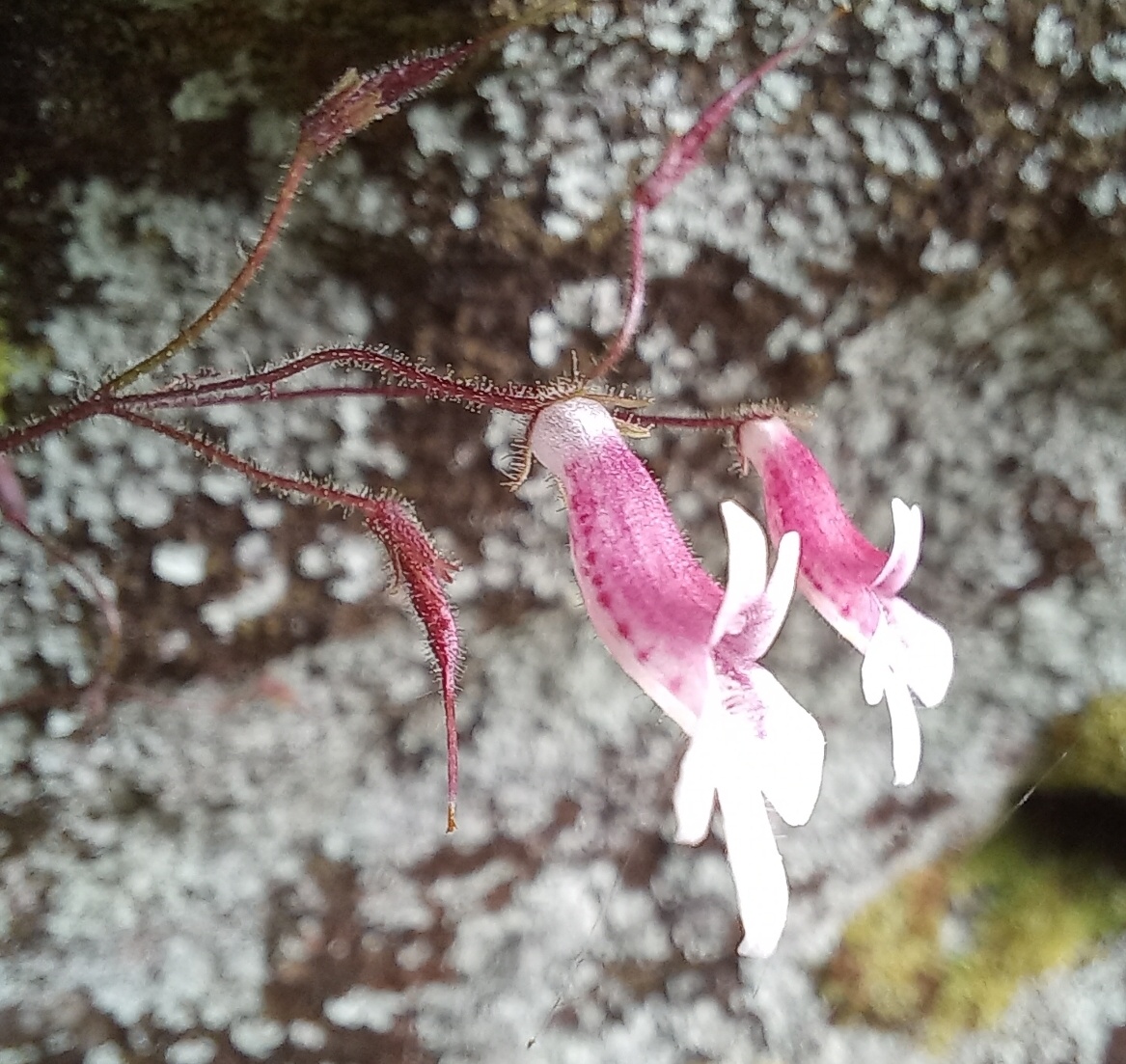
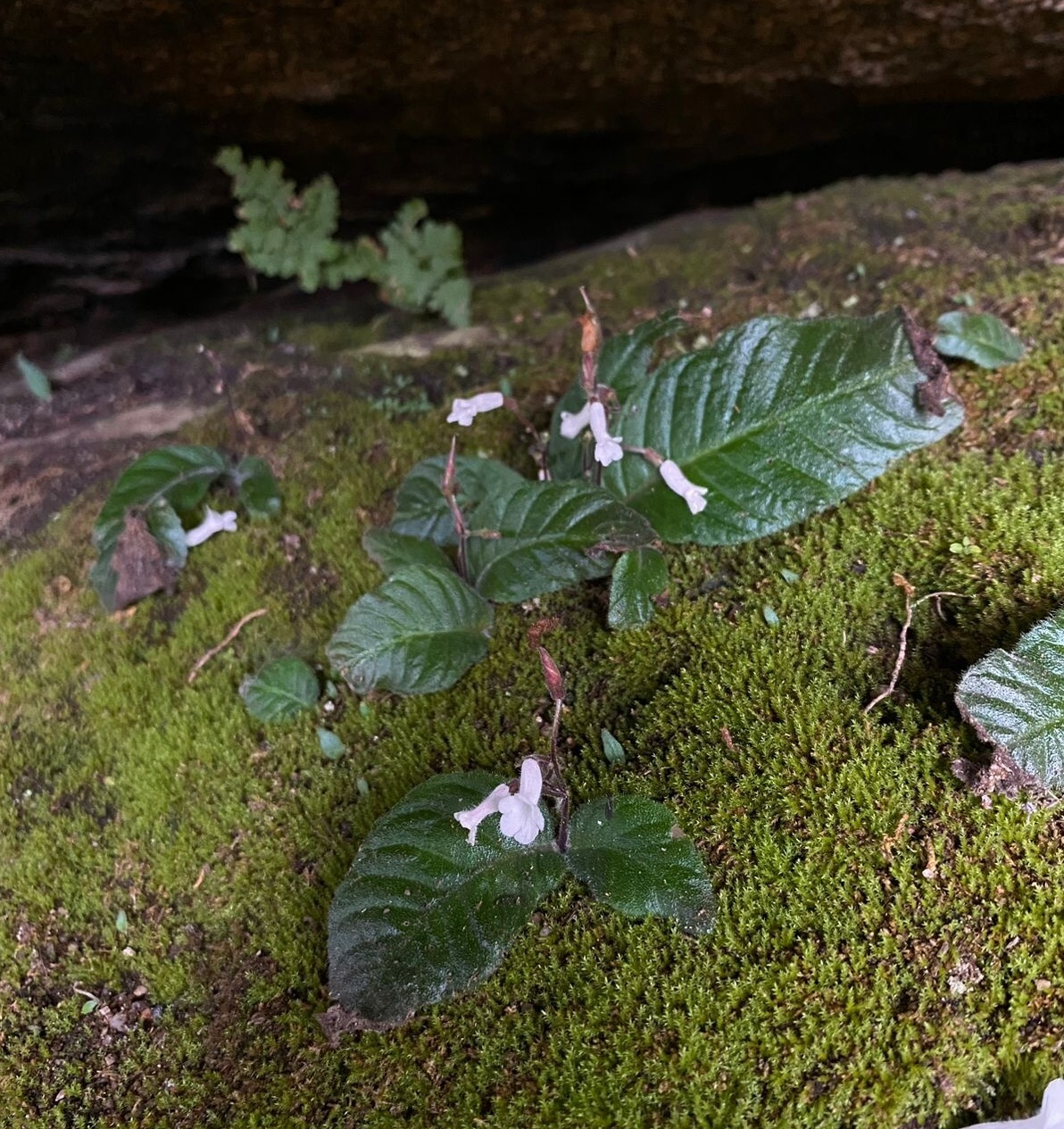
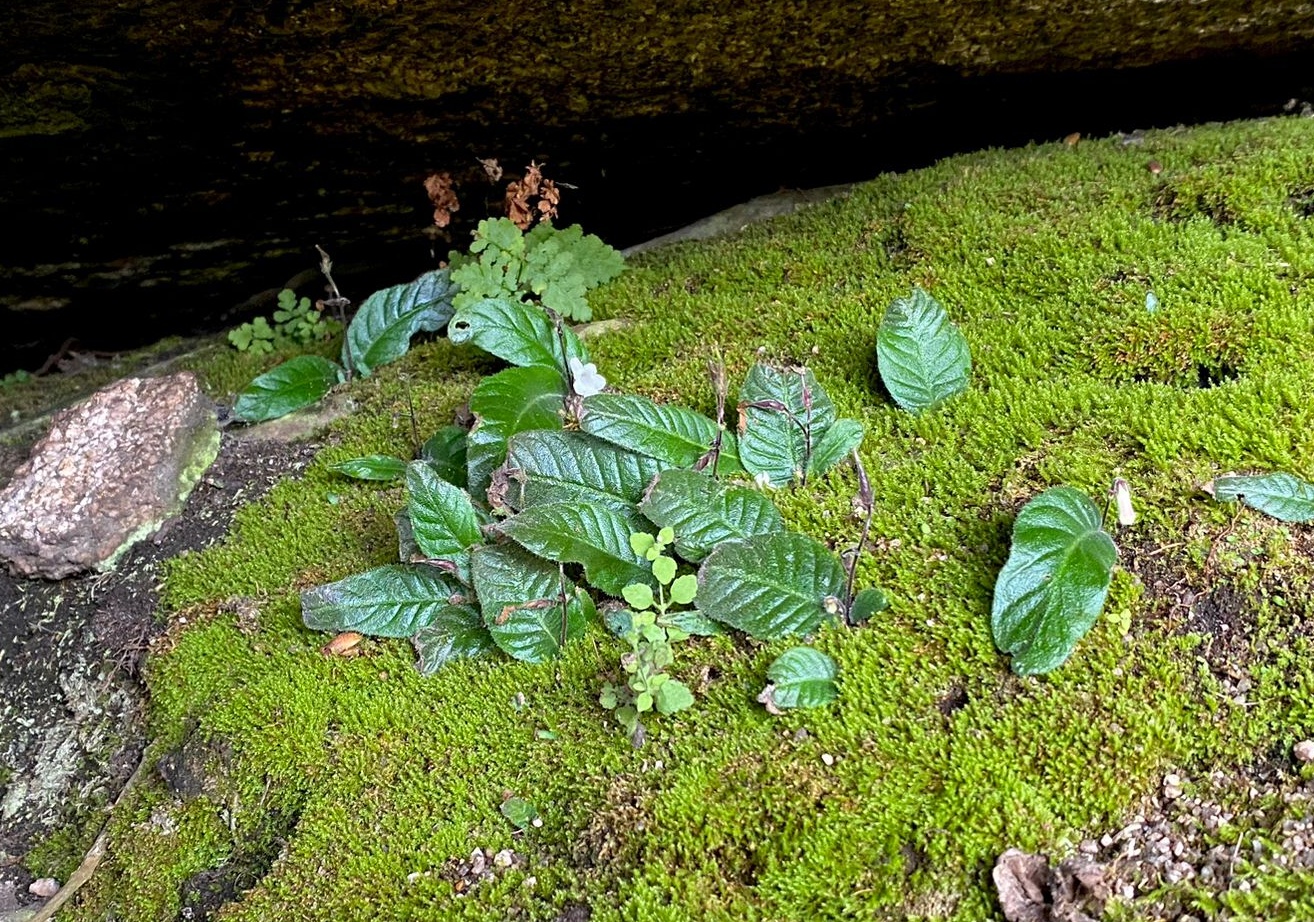
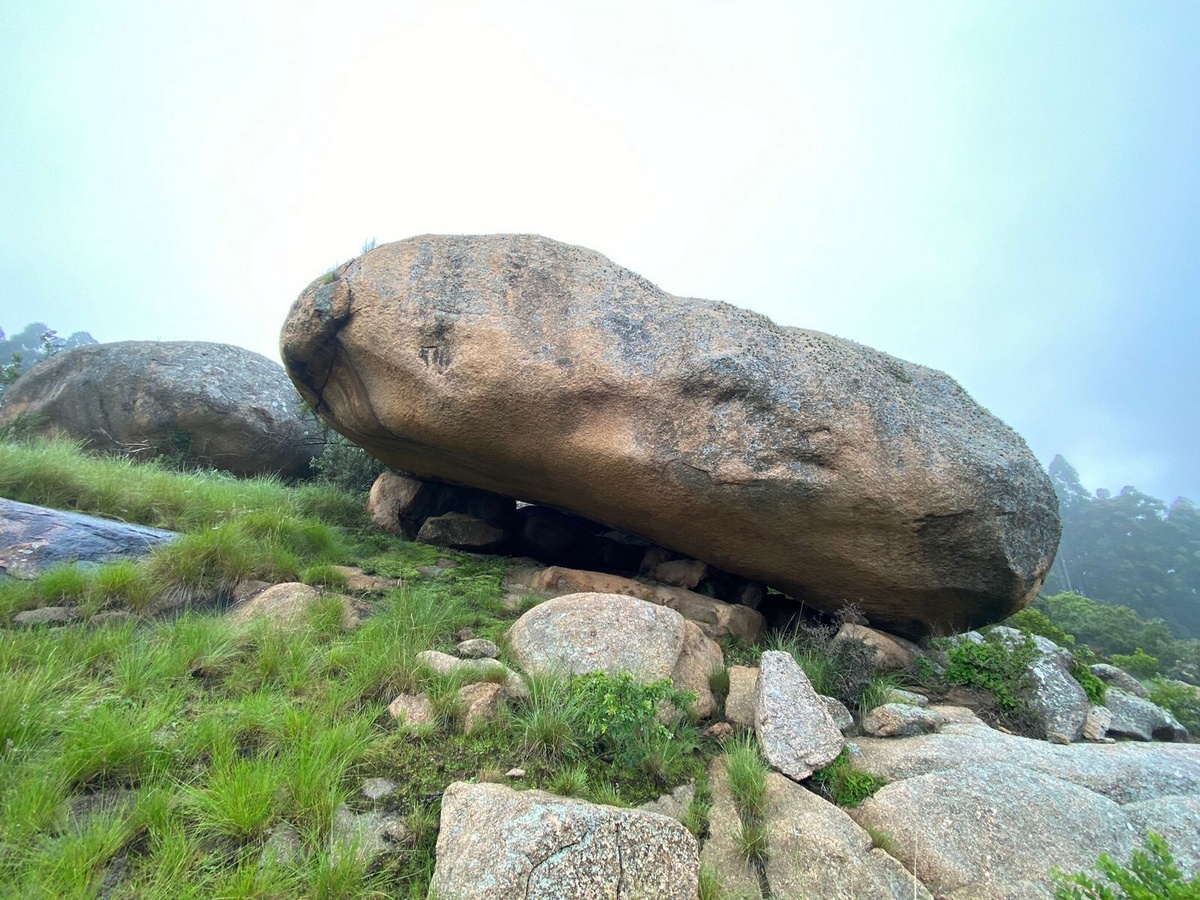
Streptocarpus occultus is a small monocarpic, unifoliate species originally thought to be another isolated population of Streptocarpus rimicola, but was then raised to species level in 1992 by Olive Hilliard. The species grows in rock fissures and caves under huge granitic boulders in grassveld in the south eastern Mpumalanga Province of South Africa, near the Eswatini (former Swaziland) border.
S. occultus has small leaves (10-20 mm wide x 30-50 mm long) and small faint pink to white flowers (15 mm long). It is threatened by exotic tree plantations which have been planted and replace the grassveld thereby given more shade to localities and reducing water runoff when it rains.
- A small group of flowering plants on moss
- Another colony on moss
- An enormous suspended rock, in the shade of which the species grows